If I want to rent out a 30A property, I have to clear three checks first: county zoning, Walton County short-term rental rules, and any HOA or condo limits. If one says no, the rental plan can fail.
Here’s the short version:
- I need to confirm the parcel’s zoning district in unincorporated Walton County
- I need to check whether short-term rentals are allowed for that type of home
- I need a Walton County short-term vacation rental certificate for each unit, renewed every year
- I also need DBPR licensing, Florida tax registration, and a Walton County TDT account
- I need to follow rules on occupancy, parking, trash, and noise
- I still have to read HOA, condo, or CC&R rules, because private rules can block nightly rentals even when the county allows them
A few numbers matter right away:
- The 30A corridor runs about 24 miles
- Walton County can issue fines up to $500 per day, per violation
- Quiet-hour enforcement is stricter from 10:00 p.m. to 6:00 a.m.
- Short stays of 6 months or less can face a 12.0% total tax
- 6.0% Florida sales tax
- 1.0% county surtax
- 5.0% Tourist Development Tax
Here’s the main point in plain English: zoning tells me what the land can be used for, county rental rules tell me how I must run the property, and HOA rules can still be stricter than both.
A fast check before I buy or list:
| Check | What I need to confirm | Why it matters |
|---|---|---|
| Parcel zoning | County zoning district and overlays | This controls base land use, setbacks, density, and parking |
| Rental status | Whether the home fits county short-term rental rules | This affects licensing, taxes, and the county certificate |
| Private rules | HOA, condo, and CC&R rental limits | These can block short stays even if county rules allow them |
| Site setup | Bedrooms, septic, parking, and past work | These can limit occupancy or trigger county action |
| Paperwork | DBPR, DOR, TDT, and annual county renewal | Missing paperwork can lead to fines |
If I’m sizing up a 30A rental, that’s the whole game: check the parcel, check the paperwork, check the private rules, and check the property setup before counting on rental income.
Zoning basics for 30A rental properties
Start with the parcel’s zoning district, then check what that district allows. That’s the first gate. Zoning decides whether a property can legally fit your rental plan, how many units can go on the lot, how much parking you need, and how close buildings can sit to the property lines.
How zoning works in unincorporated South Walton
Communities along 30A sit in unincorporated South Walton. So they follow Walton County’s Code of Ordinances and Land Development Code, not a separate city zoning code. In plain English, the county decides what you can build, how you can use it, and whether short-term rentals are allowed.
Each property along 30A has a county zoning district. That district sets the rules for permitted uses, density, setbacks, and parking. On top of that, overlay districts like the Route 30A Scenic Corridor Overlay can add extra design and site rules for parcels along County Road 30A. So before you look at rental income, unit mix, or renovation plans, you need to know the zoning label on the parcel.
Residential districts and rental use categories
Walton County’s Land Development Code splits land into districts, and each district has a table showing what uses are allowed, conditional, or prohibited. A conditional use needs added county approval before it can move ahead.
For rental buyers, the big issue is simple: does the district allow short-term vacation rental use? County planning guidance says short-term vacation rentals are allowed in any zoning district where single-family residential uses are permitted. That includes many of the lower-density residential areas along 30A, as well as mixed-use and resort districts.
Some districts can also support multifamily projects. These include Neighborhood Infill, General Commercial, Coastal Center Mixed Use, Coastal Village, Village Mixed Use, Town Center, and Resort. But those districts come with their own rules on density, parking, and design. Once you know the district, the next move is to check the county’s short-term rental rules for that parcel.
Zoning district comparison for rental buyers
The table below gives a quick look at the main zoning categories that matter for 30A rental buyers.
| Zoning District | Typical Dwelling Types | STR Eligibility | Key Issues to Confirm |
|---|---|---|---|
| Residential Preservation | Single-family detached | Allowed where single-family is permitted | Residential-only; no nonresidential uses. |
| Neighborhood Infill | Single-family, attached, multifamily | Allowed | Density can reach 8 units per acre, and in some Gulf-front or near-30A areas 12 units per acre; parking and design standards apply. |
| Coastal Center Mixed Use | Multifamily, mixed-use | Allowed | Mixed-use and compatibility standards apply. |
| Village Mixed Use / Town Center | Attached, multifamily, mixed-use | Allowed | Higher-density configurations are possible, but density and parking standards still matter. |
| Resort | Multifamily, lodging, resort-style units | Allowed | Tourism-focused development with density, height, and buffering standards. |
For any property you’re sizing up, confirm the zoning district through Walton County’s GIS or parcel records. Then match it against the Land Development Code use table for that district. Also check for the Route 30A Scenic Corridor Overlay and any Coastal Dune Lake Protection Zone. Those extra layers can change setbacks and impervious-cover limits, which can affect pools, parking, additions, and future rental income. Next, review Walton County’s short-term vacation rental rules for that property type.
sbb-itb-d06eda6
Short-term vacation rental rules in Walton County
If your zoning district allows rentals, that’s only the first step. Walton County has a separate set of short-term vacation rental rules, and those apply to the property itself.
What qualifies as a short-term vacation rental
Walton County generally treats a property as a short-term vacation rental (STVR) if it is rented more than three times in a calendar year for stays of less than 30 days or one calendar month, whichever is less, or if it is advertised or held out to the public as regularly available for those stays.
That label matters. It can trigger DBPR licensing, county certificate rules, and tax registration. Florida may also classify the property as a transient public lodging establishment, which can trigger state DBPR licensing, tax collection and remittance duties, and Walton County certificate rules. If a property is marketed for short stays before those pieces are in place, the owner can face fines and other enforcement.
Certificates, renewals, and operating standards
Each dwelling unit used as a short-term vacation rental in unincorporated Walton County must have its own Walton County Short-Term Vacation Rental Certificate, and that certificate must be renewed every year.
Before applying, the owner must already have:
- a DBPR vacation rental license
- a Florida Department of Revenue sales and use tax registration
- a Walton County Tourist Development Tax (TDT) account with the Clerk of Court
Day-to-day operation also has to meet county rules. Occupancy is usually tied to bedroom count, septic capacity, or fire-code limits. Off-street parking must be enough to keep guest vehicles off the street. Trash and noise are also common trouble spots.
Walton County enforces its Noise Ordinance more strictly between 10:00 p.m. and 6:00 a.m. Civil fines can reach $500 per day or per violation, and serious or repeat problems can lead to criminal charges.
County guidance also tells owners to post a notice inside the rental with quiet hours, maximum parking, trash procedures, and emergency contact details. In plain English, that posted notice should work like a quick compliance checklist for guests and owners alike.
Accessory units, like garage apartments or carriage houses, can run into separate occupancy, parking, and utility rules. It’s smart to confirm how the county classifies that unit before listing it.
County requirements by property type
The process is the same across rentals, but the friction points change depending on the property.
| Compliance Point | Newly Built Vacation Rental | Home Converted to Rental Use |
|---|---|---|
| Parking | Designed to meet county expectations from the start, with guest turnover in mind | Existing driveway or lot layout may not support enough spaces without retrofits |
| Occupancy calculation | Bedroom layout, septic capacity, and fire protection can be planned around rental use | Existing layout and septic system often set the practical ceiling |
| Site design and compatibility | Easier to align with current standards for circulation and guest use | May face tighter scrutiny if the structure was not designed for higher turnover or larger groups |
| Tax and certificate setup | DBPR, DOR, and TDT steps can be completed before the first booking | Verify the property's prior legal use before relisting |
Taxes are part of compliance from day one, not something to sort out later. In South Walton, transient rentals face a 12.0% total tax: 5.0% Tourist Development Tax, 6.0% Florida sales tax, and 1.0% county surtax. That rate applies to rental stays of six months or less, so owners need to build it into pricing from the start.
How HOA rules and building restrictions can limit your rental plans
County zoning may allow rentals. That does not mean you can move ahead.
If the home sits in an HOA, condo community, or planned subdivision, private rules can still shut the plan down. A county certificate does not override HOA or condo restrictions. In many cases, those private rules are stricter than the county's.
County zoning versus HOA and condo rules
County zoning and certificate rules are public requirements. HOA covenants, condo bylaws, and CC&Rs are private documents recorded in the property's governing documents. Both apply, and the stricter rule wins.
HOAs can set minimum stay rules, rental caps, or short-term rental bans through recorded documents. Along 30A, that may mean:
- 7-night or 30-night minimum stays
- outright bans on short-term rentals
- caps on how many units can be rented at one time
Some 30A communities ban short-term rentals altogether. Others require you to use an approved rental manager, which can limit self-management and give you less control over pricing, marketing, and guest screening.
What to review before you buy or list
Before you buy or list, read the recorded Declaration and CC&Rs, all recorded amendments, condo bylaws and board rules, and recent HOA meeting minutes.
Pay close attention to words like "short-term", "transient", "minimum stay," and "lease." Those terms often tell you what the board will allow. Meeting minutes can also hint at what's coming next, such as new rental limits or tougher enforcement.
After that, ask the association for written confirmation of the current rental policy and any pending changes. You can also request a formal estoppel letter. On higher-priced 30A homes, this matters a lot. A rental plan that doesn't comply can cut into projected income fast.
County zoning versus HOA restrictions: a side-by-side comparison
Use the comparison below to separate county permission from private permission.
| Issue | Walton County Baseline | Typical HOA/Condo Rule |
|---|---|---|
| Permitted use | County rules may allow STR use | May prohibit STRs outright or limit rentals to longer-term leases only |
| Minimum rental period | County approval does not override private minimum-stay rules | Often 7-night, 30-day, or 6-month minimums recorded in CC&Rs |
| Occupancy | County sets baseline occupancy; HOAs may set a lower cap. | Associations may set lower caps than the county standard |
| Parking | County requires parking compliance. | May limit parking to one or two vehicles per unit and use towing enforcement |
| Enforcement | County enforcement can include civil infractions and fines | Fines, amenity suspension, or injunctive relief through the courts |
Before you buy or list, match the recorded rules to the parcel and to your rental plan. Then verify those documents before purchase or listing.
A step-by-step compliance process for buyers and owners
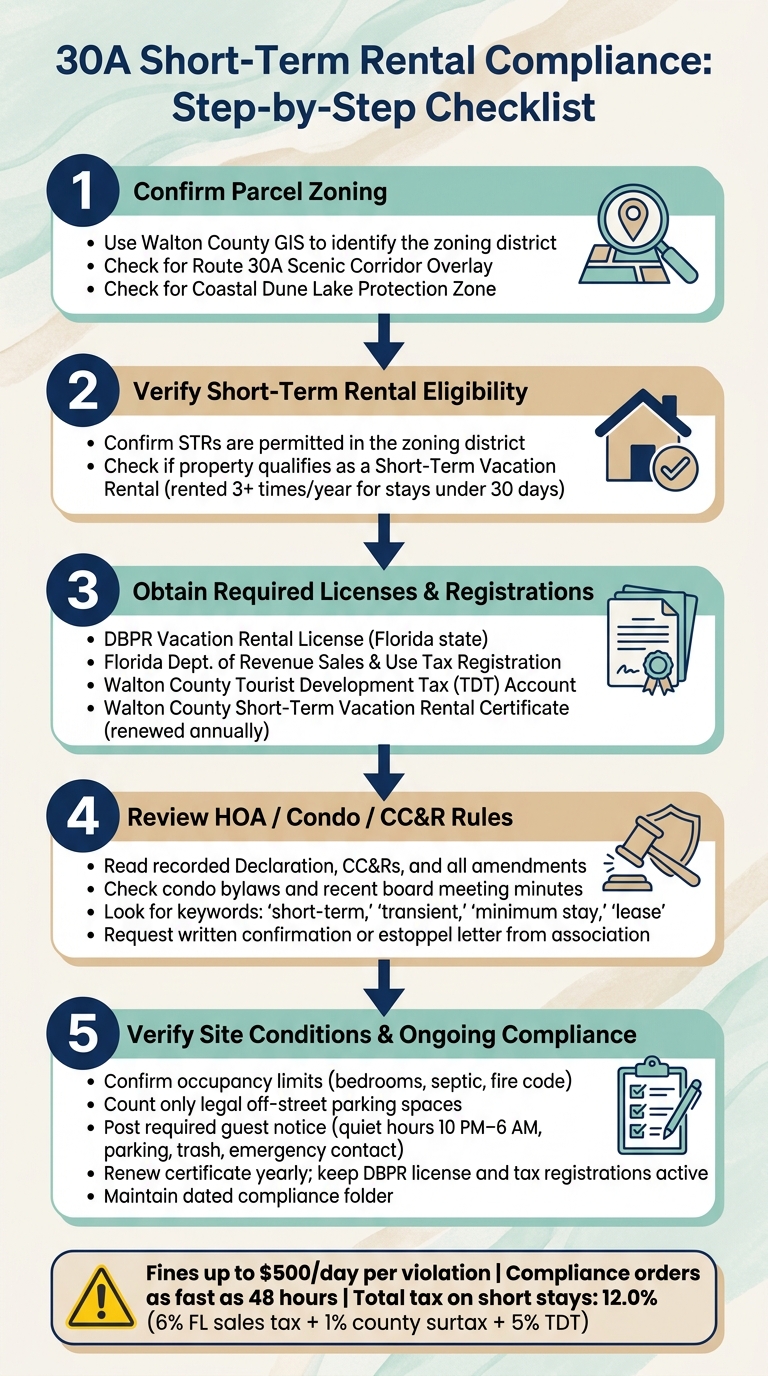
30A Short-Term Rental Compliance Checklist: 5 Steps Before You List
Use this order: parcel, county rules, HOA rules, then site conditions.
How to check a property before purchase
Once county and HOA rules are clear, run through this checklist before you buy:
- Use Walton County's interactive GIS map to confirm the zoning district and see whether overlays apply, including the Route 30A Scenic Corridor Overlay District.
- Confirm the parcel can receive a county vacation rental certificate.
- Confirm state and county registrations are in place before listing.
- Review HOA or condo governing documents for any private-use restrictions that are stricter than county rules.
- Verify the planned guest count against county occupancy limits.
- Count only legal off-street parking spaces.
If renovations are part of the plan, flag them before closing. That step can save a lot of trouble later. Adding bedrooms or expanding square footage can increase your certified occupancy limit and change the parking ratio you need to meet.
The flip side matters too. Unauthorized work - like converting a garage into a bedroom without approval - can cut allowable occupancy or even lead to certificate revocation. That's why it's smart to bring in a local architect or a code-savvy inspector before closing when remodel work is on the table.
If renovations are planned, verify them before closing.
How to stay compliant after the property starts renting
After launch, the job shifts from pre-purchase checks to keeping up with deadlines and records.
Keep accounts current. Renew your vacation rental certificate each year, and keep your DBPR license and tax registrations active. Make sure the local contact stays current and reachable 24/7.
Keep a dated compliance folder with your current certificate, DBPR license, tax registration confirmations, and any permits tied to completed work. If the county does a random interior inspection or a complaint leads to a review, having those records ready makes the response much easier.
Noncompliance can trigger fines of up to $500 per day per violation, plus fees. Hearing records also show owners being ordered to come into compliance in as little as 48 hours before daily fines start.
Check county and HOA updates each season.
Conclusion
Owning a short-term rental on 30A works only when zoning, county registration, and HOA or condo rules all line up. The practical test is pretty simple: every layer has to allow the same use. If even one doesn’t, the deal can fall apart.
And that mistake can get expensive fast. Miss one layer, and you could end up facing enforcement action and fines.
That’s why due diligence matters before you underwrite any 30A rental purchase. A buyer might verify zoning, then get tripped up by the HOA declaration and find out the rental plan won’t work after all. If you need help getting your bearings, sowal.co can give useful area context for 30A. But the final word still comes from Walton County and the association documents.
Rules on 30A can change, so check the current requirements before you buy or list. On 30A, a rental plan works only when the parcel, the county, and the community documents all say yes.
FAQs
How do I verify a 30A property's zoning?
Use the Walton County Interactive Map to look up a property's zoning district, flood zone, and any overlay districts. Just enter the address or Parcel ID.
If you need help with setbacks, neighborhood-specific plans, or other more detailed rules, contact the Walton County Planning Department's Planner on Call service. It’s also smart to check any HOA or condo documents, since they may include rental or occupancy rules that go beyond general zoning.
Can an HOA ban short-term rentals?
Yes. An HOA can ban short-term rentals, and its CC&Rs can be stricter than county rules.
So even if Walton County gives you a Vacation Rental Certificate, you still have to follow any HOA ban or rental cap. Rules can change from one neighborhood to the next, so check your community’s governing documents and CC&Rs before you buy or list the property.
What permits do I need before listing?
Before you list a short-term rental on 30A, you need to take care of a few required registrations:
- Vacation Rental Dwelling license
- Florida sales tax registration
- Walton County Tourism Development Tax account
- Walton County Vacation Rental Certificate
You’ll also need to name a local responsible party who’s available 24/7. On top of that, make sure the property is actually zoned for rentals.
And one more thing: don’t assume zoning is the only rule that matters. HOA rules can also block rentals altogether or set tighter limits on occupancy and parking.