A fire on the sand along 30A is legal, permitted, and regulated down to the inch. Walton County Code Chapter 22 governs waterways and beach activities, and the South Walton Fire District (SWFD) issues the permits that make a beach bonfire lawful anywhere from Dune Allen Beach to Inlet Beach.
Anyone planning beach bonfires in South Walton needs an approved container, a permit issued before the fire is lit, and a setup that respects fixed distance rules, including 200 feet from any marked sea turtle nest. Skipping the paperwork carries a published penalty of $500 under Walton County Resolution 2021-151.
The rules are specific enough that a well-intentioned family with a store-bought fire pit can be out of compliance in three ways at once. Container construction, fuel material, and setup timing each have their own standard, and beach patrol checks them.
Key Takeaways
- Every open flame on the Gulf beach in South Walton requires a permit issued by the South Walton Fire District before the fire is lit.
- Published fee examples run about $100 total for propane and $150 for wood, with online processing adding a few dollars; confirm current amounts with SWFD before paying.
- Approved containers, 200-foot sea turtle nest clearance, seasonal setup windows, and full ash removal are all enforceable conditions of the permit.
Do You Need a Permit for a Beach Fire?
Yes. Any open flame on the Gulf-front beach in Walton County requires a permit, and that applies to a small propane pit as much as it does to a full wood bonfire. There is no informal exemption for small groups, private beach segments, or guests staying in a Gulf-front rental.
What Walton County Code Chapter 22 Requires
Chapter 22 of the Walton County Code, covering waterways and beach activities, is the legal basis for beach fire regulation in South Walton. Under that ordinance, a bonfire or campfire on the sand must be permitted in advance and contained in a fire container approved by SWFD.
Fuel is restricted to combustible, non-toxic material free of nails, glass, and other potentially dangerous items, a requirement echoed in the county's own bonfire rules and permits page. Failing to clean up after the fire is itself a violation of the ordinance, separate from any permit issue.
Temporary Permits vs. Gulf-Front Owner Registration
Two distinct paths exist, and they are not interchangeable. A temporary beach bonfire permit covers a single night and is the route most visitors take, with the applicant supplying their own fire container and burning material.
Gulf-front property owners follow a different track: they register their property with SWFD to obtain permits, and those permits expire December 31. Owner permits are non-transferable and specific to the owner, date, and location, so a tenant, renter, or houseguest cannot use one.
SWFD states plainly on its beach bonfires page that property owners adjacent to the Gulf must register in order to obtain permits.
Where a Permitted Fire May Be Held
Permitted fires are held on Gulf-front beach, either at a public beach access or on a private beach segment with written permission from the property owner. Someone renting in Santa Rosa Beach or Seagrove should never assume the rental's beach frontage carries fire rights.
Hiring a licensed South Walton bonfire vendor changes the logistics, not the law. The vendor purchases the temporary permit with prior authorization, and confirming that the vendor is properly permitted remains the customer's job.
How to Apply and What It Costs
SWFD is the permitting authority for every beach fire in South Walton, and applications go through the district rather than the county directly, even though both collect a portion of the fee. Permits run on a fixed clock: all permits start at 4 p.m. on the date selected and expire at 1 a.m. the following day.
Applying Through the South Walton Fire District
The online bonfire permit request form is the standard entry point. Administrative staff handle questions Monday through Friday during business hours, roughly 8 a.m. to 4 p.m., and the district publishes a bonfire email address along with the phone number listed on its beach bonfires page.
Submit well ahead of the date. Vendors typically report that standard permits are released two weeks before the event date, with each beach limited to a set number of permits per day, so popular summer Saturdays fill.
Published Wood and Propane Fee Examples
Walton County publishes the following fee structure, with both portions collected by SWFD:
| Fuel type | SWFD portion | County portion | Total | Online |
|---|---|---|---|---|
| Propane | $50.00 | $50.00 | $100.00 | $105.00 |
| Wood | $50.00 | $100.00 | $150.00 | $157.00 |
Treat these as published examples. Fees are established through local ordinances and resolutions, and Walton County has revised bonfire permit rules and fees more than once, so confirm the current amount with SWFD at (850) 267-1298 before budgeting.
Age, Attendance, Weather, and Vendor Logistics
The applicant must be 18 or older, and the person who obtained the permit has to be present for the duration of the fire with the approved permit available on site. Fire officials and law enforcement can request it at any time, and SWFD reserves the right to check compliance without notice.
Groups of 30 or more require proof of a Walton County special event permit, submitted along with the bonfire request. Weather matters too: a burn ban, red-flag conditions, or high wind can block issuance or revoke an approved permit, and refunds and rainchecks are not typically granted when that happens.
Rules for Containers, Placement, and Cleanup
The container specifications and distance rules do most of the enforcement work on the beach, and both are measurable on sight. A galvanized tub, a burn barrel, or a bottomless fire ring will not pass inspection.
Approved Fire Pits and Fuel Materials
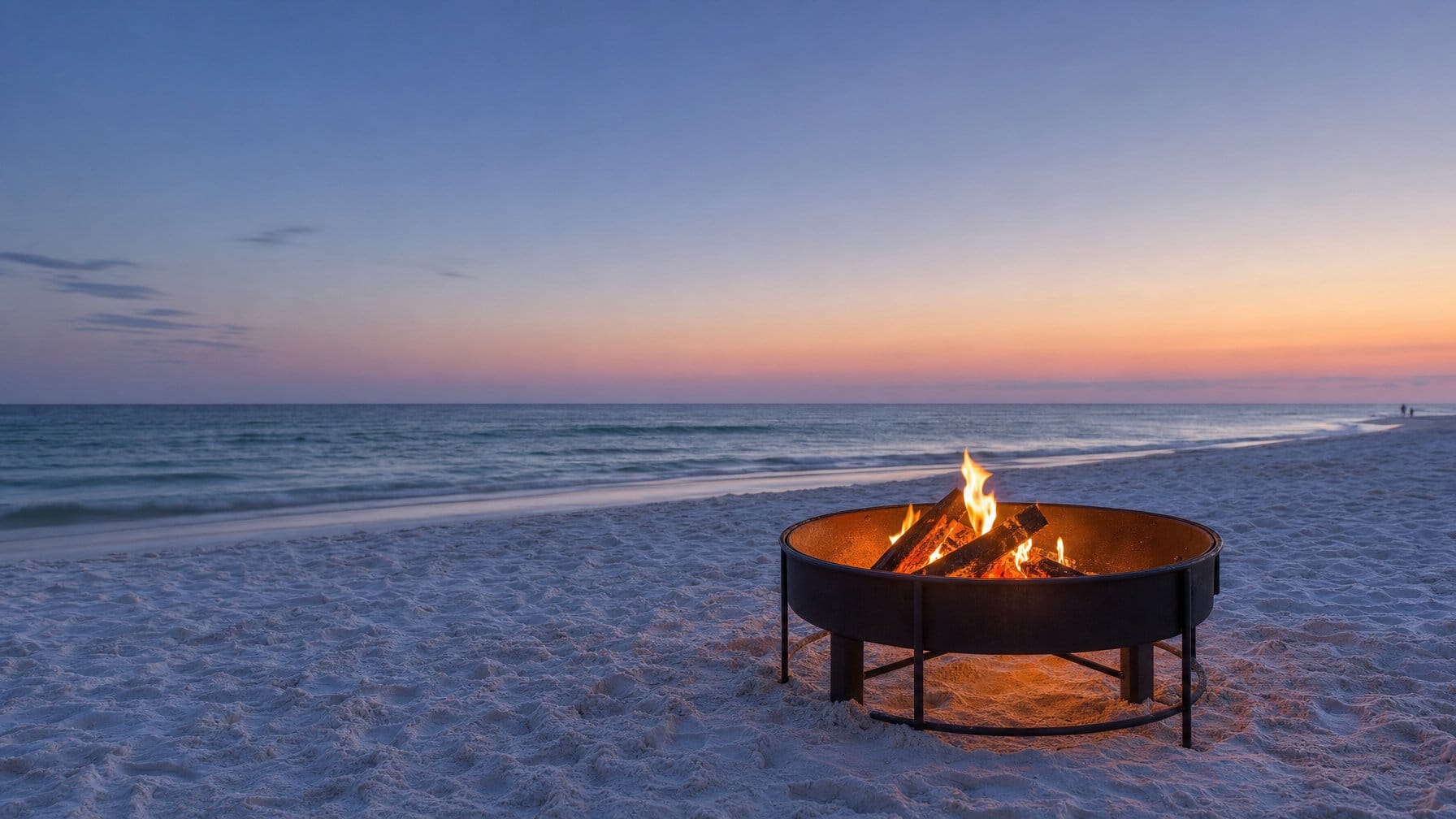
Wood fire pits need a solid steel bottom sitting at least 4 inches off the sand. Propane pits must be UL- or CSA-listed, run on a bottle no larger than 20 pounds with a regulator hose of at least 5 feet, measure no more than 3 feet in diameter, and also sit at least 4 inches above the sand.
Cooking attachments on the fire pit are prohibited, and charcoal grills are unlawful on the beach. SWFD's current guidelines note that small propane grills using cylinders of 1 pound or less with a cooking surface of 225 square inches or less may be permitted separately; confirm that with the district before packing one.
Fuel rules are equally firm:
- No flammable liquids, including lighter fluid and gasoline
- No pressure-treated or creosote lumber, tar paper, rubber, or glue-impregnated material
- No plastic, foam, or household trash
- Wood free of nails and other metals
- Ignition with paper and matches only
Distance Rules and Sea Turtle Nest Protection
The setback distances published in the beach bonfire guidelines apply to every permitted fire:
- 200 feet from a marked sea turtle nest
- 100 feet from any habitable structure
- 50 feet from vegetation and dunes, vehicles, public roads, and other structures
- 30 feet from another permitted fire on a County-maintained beach
Nesting season runs through the warm months, and marked nests appear and disappear along the shoreline daily. Walk the intended spot before the fire is built, since a stake that was not there yesterday changes where the pit can legally sit.
Seasonal Setup Windows and On-Site Safety
Setup timing shifts twice a year. From March 1 through October 31, pits and materials cannot be on the beach before 5:00 p.m., and all remnants must be removed by midnight. From November 1 through the last day of February, the window opens at 4:00 p.m. and closes at 11:00 p.m.
Equipment has to be hand-carried unless the permit holder also holds a beach vehicle permit. A maximum of 6 tiki torches is allowed per event, and a working 5-pound ABC extinguisher with a current NFPA 10 tag must be on site.
Extinguishment, Restoration, and Permit Penalties
Wood fires are extinguished with water, and the container leaves the beach with the group. Ashes and leftover material must be carried out, never buried in the sand, never dumped in beach garbage stations, dunes, or parking areas.
The standard is a site left clean, dark, and flat. Lighting a beach fire without a permit violates both SWFD and Walton County ordinances, with a published penalty of $500 under Walton County Resolution 2021-151, and the permit itself does not relieve the applicant of liability for damages caused by careless setting, tending, or extinguishing of a fire.
A Permit-First Plan for a Safer 30A Bonfire
Beach bonfires along 30A work best when the permit is secured first and the equipment is chosen to match the published specifications. Book through SWFD ahead of the date, pick propane or wood knowing the fee difference, and measure the container before it goes in the car.
On the day itself, check wind and any active no-burn orders in the morning, confirm the setup window for the season, and scan the site for marked turtle nests before unloading. Bring the tagged extinguisher, trash bags, and water for extinguishment, and plan to carry every trace of the fire back off the sand.
Fees, forms, hours, and container standards change through county ordinances and SWFD updates. Verify the current requirements with the South Walton Fire District at (850) 267-1298 before paying for a permit or hiring a vendor.
Frequently Asked Questions
Do I need a permit to have a fire on a Walton County beach?
Yes. Every open flame on the Gulf beach, including propane pits and small wood fires, requires a permit issued by the South Walton Fire District before the fire is lit. There is no exemption for small groups or guests of Gulf-front rentals.
How much is a Walton County beach bonfire permit?
Walton County publishes a propane bonfire total of $100.00 ($50 to SWFD plus $50 to the county), or $105.00 online, and a wood bonfire total of $150.00 ($50 to SWFD plus $100 to the county), or $157.00 online. Both portions are collected by SWFD, and fees are set by local ordinance, so confirm current amounts before paying.
Can a renter or visitor use a gulf-front owner's beach bonfire registration?
No. Gulf-adjacent property owner permits are non-transferable and specific to the owner, date, and location. Renters, tenants, and visiting guests need their own temporary one-night permit, or a permitted vendor purchasing one on their behalf.
Can I bring my own fire pit to a 30A beach?
Only if it meets SWFD container standards. Wood pits require a solid steel bottom at least 4 inches off the sand, and propane pits must be UL- or CSA-listed, no more than 3 feet in diameter, with a bottle of 20 pounds or less. Bottomless fire rings, galvanized tubs, burn barrels, and charcoal grills are not permitted.
What happens if my beach bonfire has 30 or more guests?
Groups of 30 or more require proof of a Walton County special event permit submitted with the bonfire permit request. The SWFD form includes a field for the special event code, which is left blank for standard requests.
Are refunds or rainchecks available if weather cancels a beach bonfire?
Refunds and rainchecks are not typically granted when weather, wind, or a no-burn order blocks or revokes a permit. Because permits run from 4 p.m. to 1 a.m. on a specific date, check the forecast before applying and contact SWFD directly about any exception.