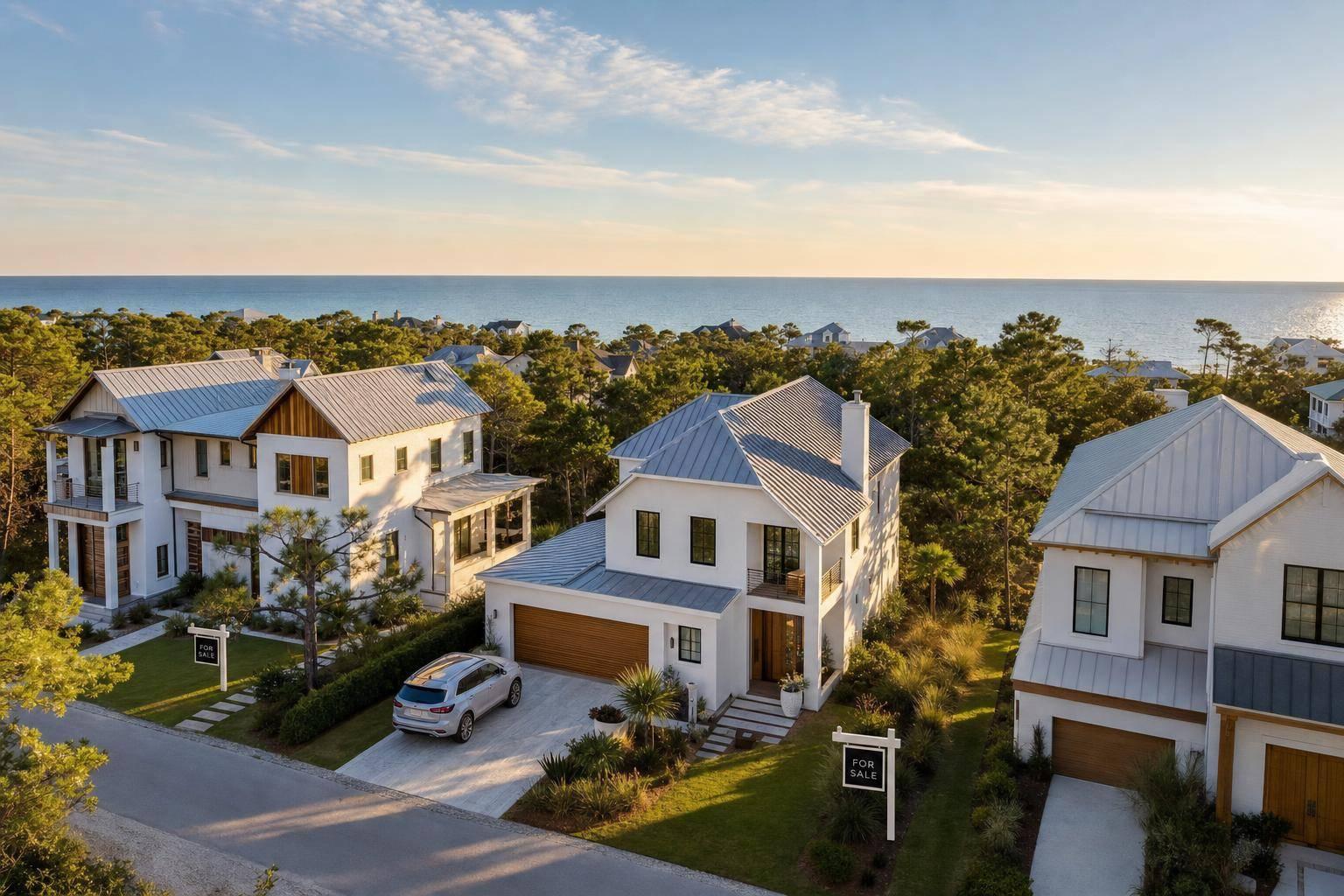
If you're looking at inland 30A in 2026, the short version is this: buyers have more room to negotiate, but well-priced luxury homes are still moving. I’d sum up the market this way: inland homes in places like WaterSound Origins, Santa Rosa Beach, and Point Washington sit far below Gulf-front pricing, carry lower yearly costs, and now trade in a more balanced market.
Here’s what stands out right away:
- Typical inland luxury budget: about $900,000 to $1.8 million
- WaterSound Origins median sale price: about $967,000
- Santa Rosa Beach median sale price: a little over $1.01 million
- Inland days on market: about 90 to 120 days in many upscale pockets
- Seller giveback: homes across Walton County are selling at about 94% to 95% of asking
- Gulf-front gap: many Gulf-front homes start near $2.25 million to $2.55 million, with average sold pricing near $9.7 million
So if I were a buyer, I’d see inland 30A as a value and lifestyle play, not a beachfront scarcity play. You give up direct Gulf frontage, but you often get more house, newer construction, lower insurance costs, and less price risk.
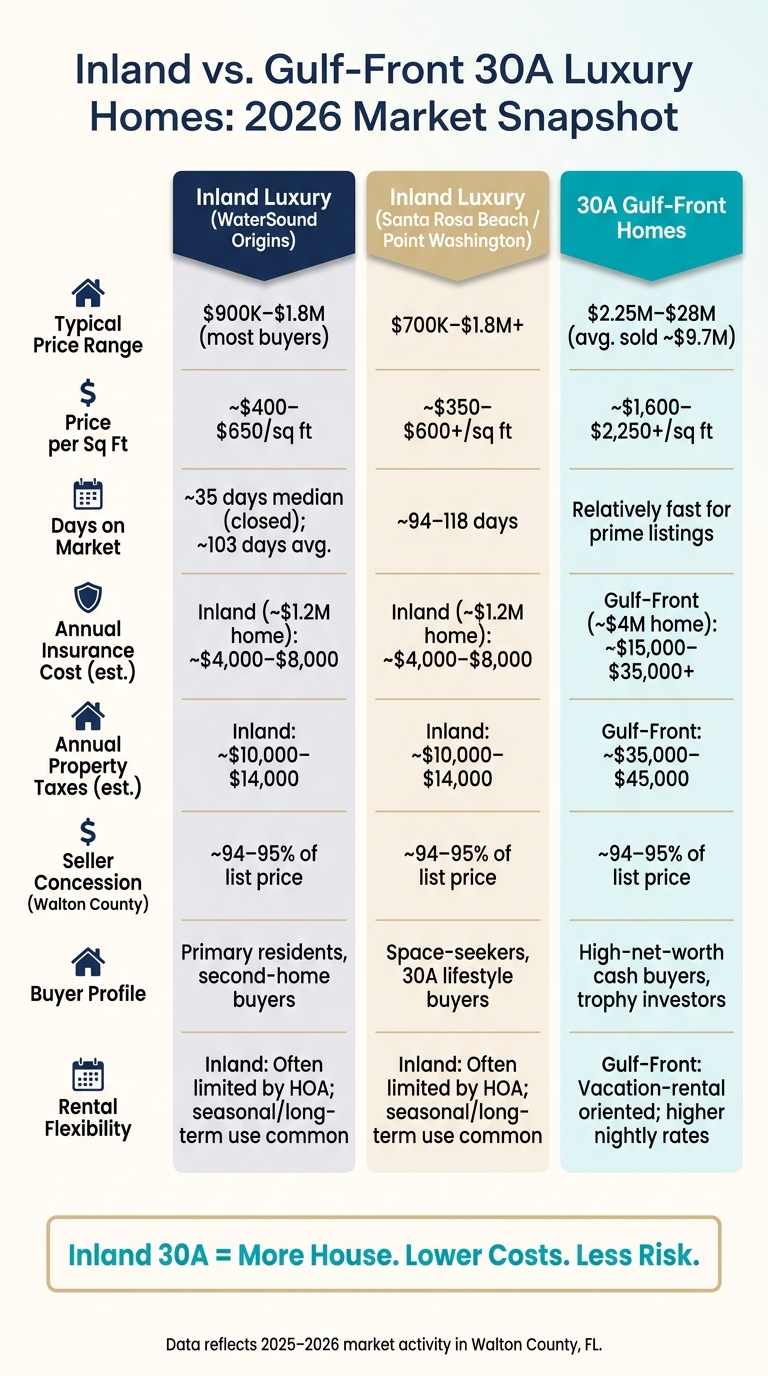
Inland vs. Gulf-Front 30A Luxury Homes: 2026 Market Snapshot
Quick Comparison
| Segment | Typical Price Range | Price per Sq. Ft. | Buyer Profile | Market Pace |
|---|---|---|---|---|
| WaterSound Origins | $900,000 to $1.8 million for many buyers | about $400 to $650 | Primary residents, second-home buyers | Balanced; around 35 median DOM on closed sales, with more choice for buyers |
| Santa Rosa Beach / Point Washington inland | about $700,000 to $1.8 million+ | about $350 to $600+ | Buyers who want space and 30A access | Slower than peak years; often 94 to 118 DOM |
| 30A Gulf-front homes | about $2.25 million to $28 million | about $1,600 to $2,250+ | Cash-heavy luxury buyers | Firmer pricing due to low supply |
Bottom line: I’d treat inland 30A as a separate luxury market with its own rules. The main things to watch are price, price per square foot, days on market, inventory, rental limits, and carrying costs. That frame makes it much easier to judge whether a listing is priced right in 2026.
sbb-itb-d06eda6
Pricing benchmarks in inland luxury neighborhoods
Walton County medians land at about $640,000 to $709,000, and price per square foot sits near $412 to $524. Inland luxury homes near 30A come in well above those county marks, but they still sit far below Gulf-front pricing.
WaterSound Origins and similar inland communities
WaterSound Origins is the clearest comp for inland luxury pricing. In the 12 months ending July 25, 2026, the community logged 234 closed sales, with a median sale price of about $967,000 and a median days on market of about 35 days. Inventory is around 4.1 months, which points to a balanced market with a bit of buyer leverage.
Active listings average about $1,222,201. Active price per square foot averages roughly $474, with a range of about $297 to $830 per sq ft based on the sub-neighborhood, build quality, and lot type. That range matters. A home in one pocket of the community can price very differently from a similar-size home elsewhere.
Most move-up and luxury buyers shop in the $900,000–$1,800,000 band. That’s where they usually find 3- to 4-bedroom single-family homes from about 2,000 to 3,000+ sq ft in enclaves such as Powell Landing East, Arborview Park, and NatureWalk. Custom and estate-style homes can stretch past 4,000–4,900 sq ft, and some deals have closed near $4.1M.
Inland Santa Rosa Beach and Point Washington price ranges
Late-June 2026 data put average home value around $857,000, median sale price just above $1,012,000, and median list price near $1,210,000 for Santa Rosa Beach overall. Active listings average about $1.18M, with an average active price per square foot near $425 per sq ft.
For inland upscale buyers in Santa Rosa Beach and Point Washington, the sweet spot is usually $700,000 to $1,800,000. In that range, buyers are often looking at 3- to 5-bedroom homes with modern coastal finishes and access to bayfront areas or key 30A routes. Premium estates can move into the multi-million-dollar range.
Listings under $500,000 are usually a different story. They tend to be older homes, smaller homes, or homes that need work. That’s not the polished, move-in-ready product most buyers mean when they talk about the inland luxury segment.
Inland upscale homes vs. Gulf-front 30A pricing
The price gap between inland luxury and Gulf-front homes is big. True Gulf-front single-family homes on 30A usually start around $2,250,000–$2,550,000 at the low end, while average sold prices are near $9,700,000. Price per square foot often runs $1,600–$2,250+ on prime frontage.
Here’s how the main segments line up in 2026:
| Area | Typical Price Range (2026) | 2026 Price per Sq Ft | Typical Home Size |
|---|---|---|---|
| WaterSound Origins | ~$500,000–$3,000,000+ (most buyers $900,000–$1,800,000) | ~$400–$650/sq ft | ~1,500–3,000+ sq ft; estates ~4,000–4,900 sq ft |
| Inland Santa Rosa Beach / Point Washington | ~$700,000–$1,800,000+ (estates $2,000,000–$3,000,000+) | ~$350–$600+/sq ft | ~2,200–3,500+ sq ft; custom homes 4,000+ sq ft |
| 30A Gulf-front single-family | ~$2,250,000–$28,000,000 (avg. sold ~$9,700,000) | ~$1,600–$2,250+ per sq ft | ~1,200–4,000+ sq ft; trophy estates 8,000–12,000+ sq ft |
That spread explains a lot. Inland buyers give up Gulf frontage, but they often get more square footage, newer homes, and lower carrying costs in return. It’s a straightforward trade, and in 2026 it plays a big role in who shops inland and how much negotiating room they have.
Demand trends and market balance in 2026
The inland luxury market near 30A has moved into a more balanced, more selective phase. The pandemic-era rush is over. Buyers are taking their time, comparing homes, waiting for the right fit, and negotiating when they see an opening. That makes the market healthier, even if it also feels slower. And it helps explain who is buying inland in 2026.
Primary residents, second-home buyers, and selective investors
Three buyer groups are driving inland activity in 2026.
Primary residents include relocating families and working professionals who want larger lots, newer homes, and quieter streets in master-planned communities like WaterSound Origins and North Santa Rosa Beach. For these buyers, day-to-day living matters. Trails, community pools, and easier access to schools and daily services carry more weight than they do for vacation buyers.
Second-home buyers still make up a big share of the inland market. They want the 30A lifestyle - beach access, restaurants, and warm weather - but without Gulf-front pricing or direct-waterfront insurance costs. Put simply, inland gives them a way to stay close to the coast without paying top-dollar for the front row.
Selective investors fill out the third group. Many inland communities limit short-term rentals, which pushes demand more toward owner-occupants and long-term holders. The investors who are still active inland tend to think in longer time frames. They see price stability and livability as the base for future appreciation.
Inventory, days on market, and buyer leverage
Days on market have stretched well beyond pandemic lows. In inland luxury pockets such as North Santa Rosa Beach and Point Washington, listings are seeing roughly 94–118 days on market. WaterSound Origins finished 2025 in a neutral market position, with average days on market at about 103 days in one recent snapshot, down from around 131 days earlier - but still nowhere near the frenzied pace of 2021–2022.
That gives buyers more choice and more room to negotiate. But this is not a distressed market. Across Walton County, sellers are still getting about 94–95% of list price. So the story isn't "buyers can slash prices across the board." It's more specific than that.
Well-priced, move-in-ready homes in sought-after inland communities are still selling within normal market timing. The homes that linger are usually overpriced or poorly positioned. That's where buyers have the clearest leverage - on price, contingencies, and closing timelines. And that contrast becomes even more obvious when you stack inland demand against Gulf-front demand.
Inland demand vs. Gulf-front demand
The gap between inland and Gulf-front demand is pretty stark. Inland buyers tend to be practical. They're weighing value, lifestyle fit, and long-term livability. Gulf-front buyers are driven more by scarcity. There are only so many true beachfront homes along 30A, and high-net-worth cash buyers are still competing for them. That keeps pricing firm even as the broader market has slowed to a more normal pace.
| Segment | Typical Buyer Type | Common Budget Range (2026) | Days on Market Direction | Pricing Pressure |
|---|---|---|---|---|
| Inland Luxury (30A area) | Primary residents, second-home users, selective investors | Roughly $900,000–$1,800,000+, depending on community and size | ~90–120 days; balanced market | Moderate; premiums are mostly limited to the best-located, best-finished homes |
| Gulf-front Luxury (30A) | High-net-worth, cash buyers, trophy investors | Roughly $2,000,000–$10,000,000+ | Still relatively fast for prime listings | High; scarcity keeps seller pricing firm |
| Broader Walton County | Mix of local residents, move-up buyers, investors | Median around $640,000–$709,000 | About 70–90+ days; balanced county-wide | Balanced; roughly 94–95% of list price |
That middle ground matters when buyers compare appreciation potential, carrying costs, and rental rules.
Investment potential, carrying costs, and risk
That trade-off changes the math for buyers. For most inland shoppers, the goal isn't to squeeze out the biggest short-term gain. It's to balance price growth, day-to-day use, and the cost of holding the home.
Appreciation outlook vs. waterfront property
Inland homes don't keep pace with Gulf-front pricing, but they have posted steadier, more predictable gains. Gulf-front homes have more upside, but they also come with more swings because storm risk and insurance costs can hit hard.
Communities like WaterSound Origins and Point Washington show why inland luxury appeals to many long-range buyers. The buy-in is much more accessible, and price growth has tended to be steadier. WaterSound Origins recorded 5.4% growth in price per square foot and 10.4% growth in average sale price through December 2025. That's a different type of value story. It leans on livability, better infrastructure, and steady demand from people who want to use the home, not just on scarcity.
Rental strategy, insurance, and ownership costs
Inland homes near 30A usually aren't built around high-income vacation rental performance. Many master-planned communities lean more residential, which can limit short-term rental use and push owners toward longer-term tenants, seasonal use, or a simple hold-for-growth plan.
When short-term rentals are allowed inland, gross annual income on part-time use may land in the $60,000–$80,000 range. That's well below what Gulf-front homes can often produce. And lower purchase prices don't always mean a low total cost. The yearly carrying costs still matter.
For an upscale inland home worth about $1.2 million, annual ownership costs may look like this:
| Cost Category | Inland (~$1.2M home) | Gulf-Front (~$4M home) |
|---|---|---|
| Property taxes | ~$10,000–$14,000 | ~$35,000–$45,000 |
| Homeowners/wind/flood insurance | ~$4,000–$8,000 | ~$15,000–$35,000+ |
| HOA fees | ~$1,500–$3,500 | Varies; often higher |
| Routine maintenance & reserves | ~$6,000–$10,000 | Significantly higher due to salt air and storm exposure |
Walton County's average homeowners premium already sits around $5,376–$5,401 per year, which is marked as "High" at the county level. Gulf-front homes can run far above that average. Inland homes at higher elevation and farther from direct surge zones may come in closer to the low end of that range, depending on construction type and flood zone classification.
How each property type compares
In 2026, 30A buyers are weighing three things at once: price, risk, and holding cost. Not just home style. The clearest differences show up in purchase cost, rental use, and upkeep.
| Dimension | Upscale Inland Single-Family | Gulf-Front Luxury | Condos / Attached Units |
|---|---|---|---|
| Acquisition cost | ~$800,000–$1.5M+ | Often $3M–$10M+ | ~$500,000–$1.5M depending on view/amenities |
| Insurance exposure | Moderate; lower flood/wind risk at higher elevation | High; wind, flood, and surge risk drive premiums sharply higher | Shared building policy helps, but individual coverage still required; varies by building age |
| Rental flexibility | Often limited by HOA rules; longer-term or seasonal use common | More often vacation-rental oriented; higher nightly rates possible | Frequently vacation-rental friendly |
| Maintenance intensity | Predictable; owner-managed; lower salt/storm exposure | High; salt air, storm damage, and complex systems increase costs | Exterior managed by HOA; risk of special assessments |
| Long-term appreciation | Steady and resilient in communities like WaterSound Origins, driven by livability and end-user demand | Strong scarcity-driven upside, but more volatility | Building-specific; depends heavily on HOA management and fees |
Upscale inland single-family homes in well-run communities tend to offer the most predictable holding pattern. Gulf-front homes may outperform across a full market cycle, but the downside risk is real. Insurance spikes, storm damage, and shifts in buyer mood can all change the picture fast. Condos land somewhere in the middle. They are often more rental-friendly, but owners still face HOA choices and special assessments they can't fully control.
For primary residents and second-home buyers who care most about stability, personal use, and lower carrying costs, upscale inland 30A homes make the stronger risk-adjusted case in 2026.
Conclusion: Key takeaways for buyers in the 2026 inland 30A market
The inland 30A market in 2026 stands on its own. It isn't some second-choice option for beach buyers. It's a luxury segment with a different tradeoff: you give up Gulf-front scarcity and get better value plus lower holding costs.
The price gap makes that plain. In 2025, North Santa Rosa Beach had an average sale price of $913,253, and Point Washington came in at $852,301. That sits far below the $10.73 million Gulf-front average.
That same gap shows up in how fast homes move. As of early 2026, the 32459 ZIP code had 11.7 to 15.1 months of supply. In February, homes sold for 3.85% below asking, and North Santa Rosa Beach averaged 118 days on market in Q4 2025.
For buyers, this is where discipline pays off. Don't anchor your offer to Gulf-front sales. Use inland comps. That's the lane that matters here.
A few things work in buyers' favor:
- Lower entry prices
- More inventory
- More room to negotiate
- Lower carrying costs
And if a listing has been sitting for more than 90 days, that's often where the best leverage shows up.
In plain English: inland 30A tends to fit buyers who care more about livability, value, and lower carrying costs than beachfront scarcity.
FAQs
How much negotiating room do buyers have?
As of 2026, the 30A luxury market is more balanced, which gives buyers more room to negotiate.
Turnkey homes in walkable areas still tend to move fast and attract strong interest. But homes that are overpriced, or that need updates, often sit on the market longer. That opens the door for buyers to push on price, ask for seller credits, or negotiate a longer inspection period.
Timing can help too. Buyers may see the most flexibility in summer and during the quieter fall and winter months, when some sellers are more willing to work on terms.
Are inland 30A homes a good long-term investment?
Yes. Inland 30A homes are often seen as a strong long-term investment, even though they play a different part than beachfront property.
Areas like Watersound Origins and North Santa Rosa Beach tend to attract full-time residents and second-home buyers who want more privacy, larger lots, and a steadier neighborhood feel. That demand doesn’t come out of nowhere. It’s tied to limited land, strict zoning, and steady buyer interest. In many neighborhoods, rental restrictions also help support a more stable residential setting.
So while inland homes may not offer the same profile as a beachfront purchase, they often appeal to buyers who care more about space, peace, and consistency than being right on the sand.
What should I compare before making an offer?
Before you make an offer on an upscale inland home, take time to compare a few key things:
- Neighborhood rules and rental restrictions
- Property condition, with close attention to wind resistance and flood risk
- Carrying costs, including insurance, property taxes, and membership dues
It also helps to visit the property at different times of day, including weekends. That gives you a better feel for noise levels, traffic, and what local activity is actually like when the area is busy.