
You can cut rental tax bills in a few main ways: deduct interest, deduct property taxes, write off day-to-day expenses, and depreciate big-ticket costs over time.
If I own a rental, the big issue is simple: high income can come with high costs. This article explains how I can lower taxable rental income by tracking the right expenses, splitting personal and rental use the right way, and keeping records that support every claim.
Here’s the short version:
- Mortgage interest is often fully deductible for a rental used only for rental activity.
- Property taxes are usually deductible on Schedule E and are not capped by the SALT limit when tied to rental use.
- Operating costs like utilities, insurance, HOA dues, cleaning, pool service, software, and management fees can often be deducted in the current year.
- Repairs are usually deducted now, while improvements like a new roof or full HVAC replacement are usually depreciated over time.
- Depreciation can reduce taxable income each year, even when I do not spend new cash that year.
- Mixed-use homes follow day-count rules, and personal use can limit deductions if it goes past 14 days or 10% of fair-market rental days, whichever is greater.
- Recordkeeping matters: receipts, tax bills, booking calendars, and personal-use logs help support deductions.
A few numbers stand out. In some high-end vacation markets, management fees can run 20% to 35% of gross rental income, and total costs can hit 35% to 45% of gross revenue. That’s why missed deductions can cost me money year after year.
| Area | How it usually works | Common examples |
|---|---|---|
| Interest and taxes | Deduct based on rental use | Mortgage interest, property tax |
| Current expense write-offs | Deduct in the year paid or incurred | Cleaning, utilities, insurance, HOA dues |
| Repair costs | Usually deduct now | Leak repair, repainting, pool pump fix |
| Capital costs | Add to basis and depreciate | New roof, new HVAC, room addition |
| Asset depreciation | Write off over set years | Furniture, appliances, building |
Bottom line: if I classify the property the right way, separate repairs from upgrades, and keep clean records, I can lower taxable income and keep more of the rent I collect.
The Rental Property Deduction Strategy the IRS does NOT want you to know

sbb-itb-d06eda6
Mortgage interest and property taxes
Once you get past the basic write-offs, mortgage interest and property taxes are often the biggest deductible costs for luxury rentals. And because you pay them year after year, even modest deductions can make a noticeable difference in net returns.
When mortgage interest is deductible
If a property is used only as an income-producing rental, and you have no personal use beyond repairs, maintenance, or inspections, mortgage interest is generally fully deductible as a rental expense on Schedule E.
If the property has mixed use, you need to split the interest based on rental days versus total use days. The IRS may treat the property as a home for tax purposes if personal use goes over the greater of 14 days or 10% of the days rented at fair market value. When that happens, rental losses may be limited, and the deductible share can shrink. The same day-based split applies to property taxes.
How property tax deductions work for rentals
Property taxes on a rental property are usually deductible as an operating expense on Schedule E, which cuts net rental income directly. And unlike personal property taxes claimed on Schedule A, this deduction is not limited by the SALT cap.
For mixed-use properties, use the same rental-day split for property taxes. After that, the next area to look at is operating expenses, where many landlords miss write-offs.
Operating expenses that reduce net rental income
Mortgage interest and property taxes get most of the attention. But they're only part of the story.
A long list of recurring costs can be written off directly against rental income on Schedule E. The IRS lets you take a current deduction for expenses that are common and required for managing, conserving, and maintaining a rental property. That matters because each deductible dollar cuts net operating income now. You don't need to wait years to get the tax effect. For luxury rentals, some of the biggest tax misses come from everyday operating costs that owners overlook.
Day-to-day costs owners often miss
Processing fees and booking commissions count as deductible admin costs. The same goes for booking tools, pricing software, and accounting subscriptions. A channel manager that costs $150 per month, for example, adds up to $1,800 per year in deductions.
HOA or condo association dues are another item owners skip all the time. If the property is rented, those monthly fees are generally deductible as operating expenses. Pest control contracts and landscaping work can also qualify when they're part of keeping the place rentable.
In coastal markets like South Walton and 30A, these repeat costs can add up fast. Pool service, guest supplies, and even a phone line used only for the rental may all qualify as deductible operating expenses when you keep proper records. Advertising and listing fees are deductible too.
What to deduct now versus what to capitalize
Here's the basic split: routine costs are usually deducted now, while upgrades and major replacements are added to basis and written off over time.
| Cost Type | Example | Tax Treatment |
|---|---|---|
| Cleaning & turnover | Guest cleaning, laundry services, housekeeping supplies | Currently deductible |
| Utilities | Electricity, water, sewer, trash, internet, cable | Currently deductible (prorate if mixed-use) |
| Insurance | Property, liability, flood/hurricane coverage | Currently deductible |
| Management | Property management fees, booking platform commissions, software subscriptions | Currently deductible |
| Maintenance | Pool service, landscaping, pest control, HVAC filter changes | Currently deductible |
| HOA dues | Monthly association fees tied to the rental | Currently deductible |
| Guest supplies | Linens, towels, toiletries, paper products | Currently deductible |
| Major renovations | Adding a pool, upgrading to hurricane-rated windows, new deck construction | Capitalized and depreciated |
| Large system replacements | New HVAC installation, full roof replacement | Capitalized and depreciated |
| Significant landscaping | Major hardscaping or outdoor kitchen installation | Capitalized and depreciated |
A simple example makes the line clearer. Weekly pool service at $120 per visit comes to $6,240 per year and is fully deductible as a recurring operating expense. But if you build a new pool, that cost gets added to the property's basis and depreciated over time.
Get that classification wrong, and you can run into tax issues. Get it right, and you keep current deductions where they belong without dealing with later adjustments.
Repairs, improvements, and depreciation
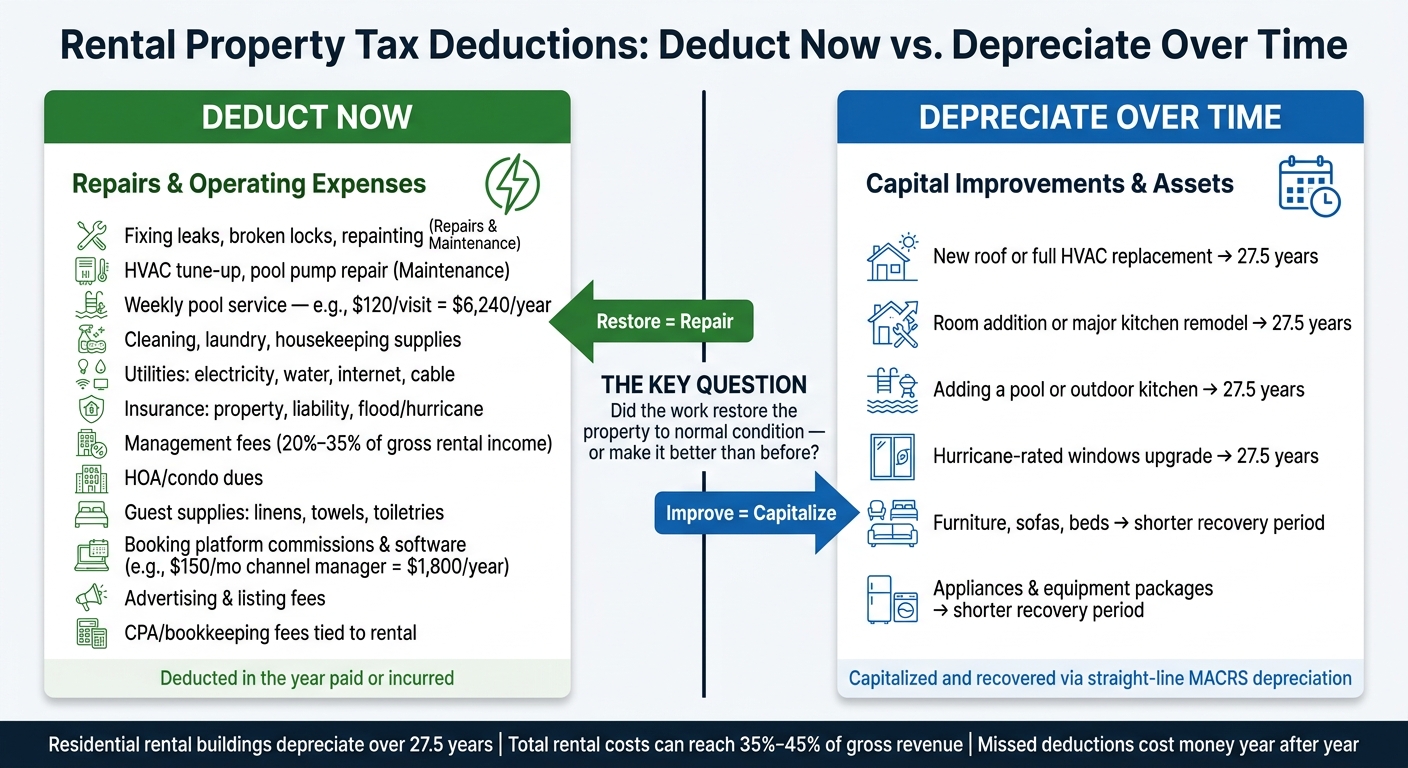
Rental Property Tax Deductions: What to Deduct Now vs. Depreciate Later
Some rental costs cut income right away. Others do it bit by bit through depreciation.
Repairs lower taxable income now. Improvements lower it over time. That split matters more than many owners expect.
Repairs and maintenance you can deduct right away
The IRS usually lets you deduct work that keeps a rental in working shape in the current year. A simple way to think about it: did the work just bring the property back to normal, or did it make the property better than it was before?
Work like fixing a leaking pipe, repainting a wall damaged by a guest, replacing a broken door lock, servicing the HVAC system, or repairing a pool pump will usually fall into the repair bucket. You can deduct those costs in the year you pay or incur them.
Bigger jobs don't get the same treatment.
Improvements and assets that must be depreciated
If you put on a new roof, do a full kitchen remodel, add a room, or replace the entire HVAC system, the IRS treats that as more than a repair. Those projects add value or stretch out the property's useful life, so you have to capitalize the cost and recover it through depreciation over time.
Furnished rentals add another layer. Sofas, beds, appliances, and other equipment are separate depreciable assets. They're not lumped in with the building itself. In many cases, they have shorter recovery periods than the structure, so you start writing off those costs sooner.
| Category | Examples | Tax Treatment | Recovery Period |
|---|---|---|---|
| Repairs & Maintenance | Fixing leaks, repainting, HVAC tune-up, pool pump repair | Deduct immediately | Current year |
| Capital Improvements | New roof, room addition, major kitchen remodel | Depreciate over time | 27.5 years for residential rental property |
| Depreciable Assets | Furniture, appliances, equipment packages | Depreciate over time | Shorter than the building |
How depreciation can lower your taxable income
Depreciation is a non-cash deduction. In plain English, you don't need to spend new money each year to claim it. Instead, the tax code lets you recover the cost of a building or asset over time as it wears down.
Residential rental buildings are generally depreciated over 27.5 years under straight-line MACRS.
That creates a useful tax effect: a property can bring in strong rental income and still show lower taxable income once depreciation is applied. That's a big reason real estate can be tax-efficient. Each year the property is in service, depreciation can chip away at taxable income.
Track each asset on its own so your depreciation stays accurate.
Recordkeeping, professional support, and key takeaways
Once you know what counts as a deduction, the next part is simple: prove it. If the IRS ever asks questions, your records do the talking.
Records you need to support your deductions
Good records help protect your write-offs if the IRS asks for backup. Keep rental records for at least seven years, especially if depreciation is part of the picture.
That means holding on to items like:
- Form 1098s
- Mortgage statements
- Property tax bills
- Proof of payment
- Insurance policies
- HOA statements
- Management invoices
- Cleaning and maintenance receipts
- Booking calendars
- A personal-use log
It also helps to use a separate bank account and credit card for the rental. That way, income and expenses stay clearly split from your personal spending.
Digital copies make life easier. Store searchable files by tax year and property so you can pull up what you need without digging through old folders.
If you run a luxury rental, go a step further. Add notes to receipts for concierge services, premium linens, pool and beach services, or security. Keep photos of amenities too. Those details can help show that the expense had a business purpose. For South Walton and 30A owners, sowal.co can also help show local guest expectations and service standards.
The same basic idea applies to anyone helping with the return: clear records matter.
When professional fees may also be deductible
CPA and tax prep fees tied to the rental, including Schedule E work and rental tax planning, are generally deductible. Bookkeeping fees and legal fees tied directly to rental operations may also count.
If one invoice includes both personal work and rental work, ask for an itemized bill. Then you can deduct only the rental share.
Fees tied to buying the property or making improvements usually have to be capitalized instead.
Key steps to lower your rental costs
A good way to handle this is to move in a clear order.
Start with mortgage interest, property taxes, and insurance. Then track recurring operating costs, sort repairs from improvements, and add capital assets to your depreciation schedule. Keep organized digital records, and review big-ticket expenses with a CPA or real estate tax advisor during the year.
Done right, this can help protect cash flow, cut net operating costs, and keep more of your rental income in your pocket.
FAQs
How do I split expenses for a mixed-use rental?
If personal use goes past 14 days or 10% of the days rented at fair market value, the IRS treats the property as a residence.
At that point, you need to split depreciation and operating expenses between rental use and personal use.
There’s a catch here: days used by friends or family count as personal use, even if they pay rent. That rule trips people up all the time.
To stay on solid ground, keep a daily log that tracks:
- Rental days
- Personal-use days
- Guest details
What counts as a repair versus an improvement?
For tax purposes, repairs keep your rental property in good working condition. In most cases, you can deduct those costs in full for the year you paid them.
Improvements are different. They add value, extend the property’s useful life, or change it for a new use. Instead of taking the full deduction right away, you must capitalize those costs and depreciate them over time.
A couple of common examples are a new HVAC system or a roof replacement.
What records should I keep for rental deductions?
Keep thorough records for at least three years to back up rental deductions and stay compliant in South Walton.
That means keeping a clear daily log of:
- Rental days and personal-use days
- Guest details
- Asset placed-in-service dates
- Total costs
- Recovery periods
- Revenue records
- Proof of required state and county registrations
Think of it this way: if you ever need to show how you reported income, claimed deductions, or tracked property use, these records do the heavy lifting.