
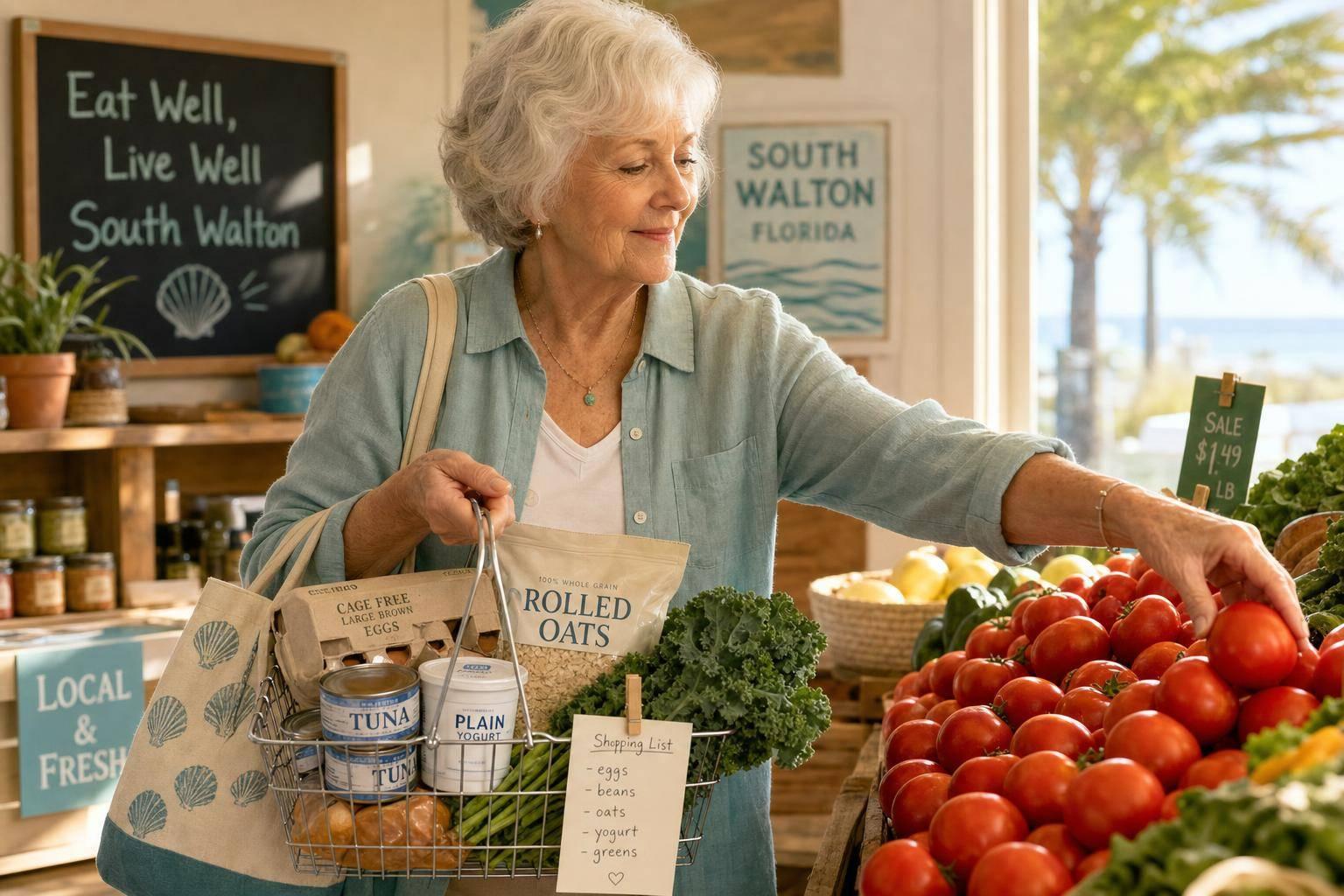
Eating well after 60 in South Walton can cost less when I focus on a few low-cost foods, plan simple meals, and use local food help when needed. In this article, I see that protein, fiber, calcium, vitamin D, vitamin B12, and water matter more with age, even though calorie needs often go down. I also see that local seniors face higher grocery prices, tourist-season price swings, transportation problems, and extra waste from family-size packages.
Here’s the short version:
- I need foods that give more nutrition per dollar, like eggs, beans, oats, brown rice, canned tuna, yogurt, bananas, cabbage, sweet potatoes, and frozen vegetables.
- Older adults often need about 1.0 to 1.2 grams of protein per kilogram of body weight per day, with about 25 to 30 grams per meal as a useful target.
- Fiber goals are about 30 grams a day for men and 21 grams a day for women over 60.
- Calcium needs can reach 1,200 mg per day, and vitamin D needs are about 600 to 800 IU per day.
- In South Walton, food costs and travel can be a problem, and 69% of households have had to choose between food and transportation.
- Living alone can make food waste worse, since many items are sold in larger packs than one person needs.
- Batch cooking, freezing single portions, using store brands, and buying frozen or in-season produce can cut costs.
- Local help includes Caring & Sharing of South Walton, ECCOA meal services, SNAP, SFMNP, and CSFP.
My main takeaway: if I keep meals simple, shop with a list, use repeat ingredients, and lean on local support when needed, healthy eating can fit a fixed income in South Walton.
That’s the core of the article, in plain terms.
12 Easy Meals Under $5 for Seniors (Cooking for One!)
The Main Challenges South Walton Seniors Face
Meeting daily nutrition goals gets tougher when food costs more and households are smaller. In South Walton, that pressure can hit hard. The area's visitor-driven economy often pushes grocery prices up, which makes routine shopping harder for seniors living on fixed incomes.
Higher Food Costs, Seasonal Pricing, and Limited Transportation
Grocery prices along 30A and in nearby resort communities are often higher than in inland areas. During peak travel periods, like summer and major holidays, those prices can climb even more. A lot of local stores are set up for short-term visitors, not year-round residents. At about $4.38 per meal, even modest jumps in cost can put pressure on a fixed budget.
Then there's the other part of the problem: getting to the store.
Lower-priced discount supermarkets are often farther away, and not every senior can make that drive with ease. That becomes even harder during tourist season, when traffic backs up and parking turns into a hassle. 69% of households have had to choose between buying food and paying for transportation. Walton County also has limited senior transportation options for general activities, which can make regular grocery runs harder to manage.
Smaller Households Create a Second Problem: More Waste from Package Sizes Built for Families
Food shopping can also feel stacked against older adults who live alone. Appetites may shrink with age, but package sizes usually don't. Many grocery items - bagged salad, bulk produce, family packs of meat - are sold with larger households in mind. For a senior living alone, that can mean paying for more than they can use before it goes bad. And roughly 27% to 28% of adults 65 and older in the U.S. live alone.
That kind of waste adds up fast. After a while, it can push people toward shelf-stable foods because they're simpler to store, last longer, and don't spoil as easily. The tradeoff is that these foods are often higher in sodium and lower in the nutrients older adults need most.
On days when energy is low or pain flares up, cooking can feel like a mountain to climb. That's when processed convenience foods often become the easiest option. They save time and effort, but leaning on them too often is linked to muscle loss, nutritional frailty, and other long-term health risks. In South Walton, even quick grab-and-go deli and bakery items can eat through a grocery budget in no time.
Affordable Foods That Deliver the Most Nutrition
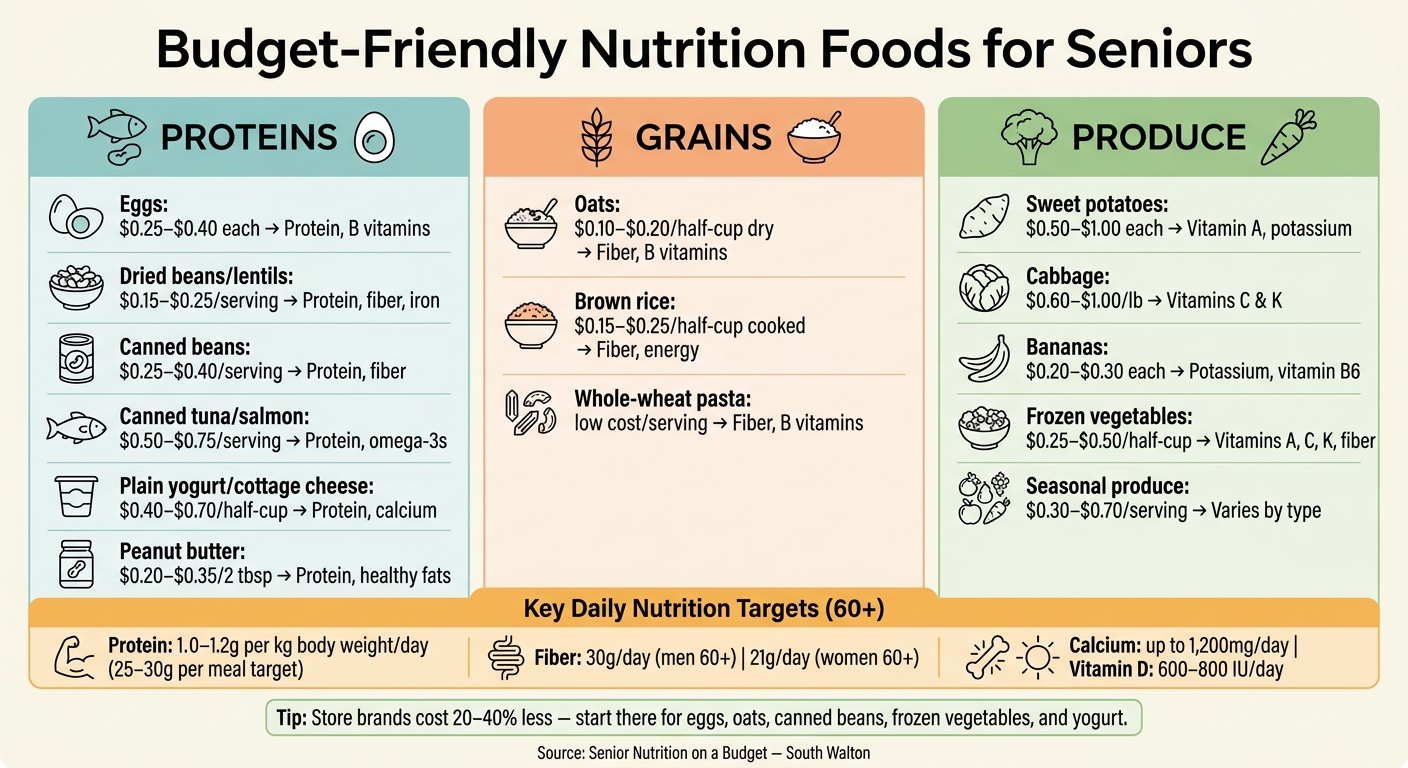
Budget-Friendly Nutrition Foods for Seniors: Cost & Benefits at a Glance
Some of the most nutritious foods for older adults are also some of the cheapest. A few simple staples - easy to find locally - can help you put together balanced meals without spending much. The goal is simple: choose foods that give you the most nutrition for each dollar.
Low-Cost Proteins, Grains, and Produce That Stretch a Grocery Budget
Protein matters more with age because it helps protect muscle and strength. Expert panels recommend about 1.0–1.2 g of protein per kilogram of body weight per day for older adults, and research suggests that about 25–30 g of protein per meal is a useful target.
Low-cost protein foods include:
- Eggs ($0.25–$0.40 each)
- Dried beans and lentils ($0.15–$0.25 per cooked serving)
- Canned beans ($0.25–$0.40 per serving)
- Canned tuna or salmon ($0.50–$0.75 per serving)
- Plain yogurt or cottage cheese ($0.40–$0.70 per half-cup serving)
- Peanut butter ($0.20–$0.35 per 2-tablespoon serving)
These foods do more than add protein. Many also supply fiber, calcium, iron, omega-3 fats, or B vitamins.
For grains, oats, brown rice, and whole-wheat pasta are smart budget picks. Oats often cost about $0.10–$0.20 per half-cup dry serving. Brown rice usually runs about $0.15–$0.25 per half-cup cooked serving. Whole-wheat pasta is another low-cost option that adds fiber and B vitamins. Foods like these can support digestion and help meals feel more satisfying.
Produce can be budget-friendly too. Sweet potatoes, cabbage, bananas, seasonal produce, and frozen vegetables all give you a lot for the price. Sweet potatoes are rich in vitamin A and potassium. Cabbage supplies vitamins C and K. Bananas are a good source of potassium and vitamin B6. Frozen vegetables bring vitamins A, C, and K, along with fiber. Typical prices look like this: sweet potatoes about $0.50–$1.00 each, cabbage about $0.60–$1.00 per pound, bananas about $0.20–$0.30 each, seasonal produce about $0.30–$0.70 per serving, and frozen vegetables about $0.25–$0.50 per half-cup serving.
When you buy canned foods, check for "low sodium" or "no salt added" on beans and vegetables. If those aren't on the shelf, drain and rinse them under water to cut some of the sodium. For canned fruit, choose "packed in water" or "100% juice" instead of syrup when you can.
How to Shop Smarter With Store Brands, Frozen Foods, and Seasonal Produce
Store brands are one of the easiest ways to lower grocery costs without giving up nutrition. For basics like eggs, oats, brown rice, canned beans, frozen vegetables, yogurt, and peanut butter, store brands often cost 20%–40% less. A good rule of thumb: start with the store brand for shelf-stable basics unless there's a clear reason to pick something else.
Frozen fruits and vegetables deserve more credit. They are often picked at peak ripeness and frozen soon after, which helps preserve vitamins A and C. For seniors cooking for one or two, frozen bags can also cut food waste. You use what you need, then keep the rest in the freezer for later.
If you're shopping at local South Walton farmers markets, ask vendors about seconds - slightly imperfect produce that's still great for soups and stews. You can also split a bulk buy of sweet potatoes or tomatoes with a neighbor to lower the cost and waste less. Use sowal.co to check local markets and see when produce is in season. That can make meal planning for one or two people a lot easier.
sbb-itb-d06eda6
Simple Meal Planning for One or Two People
Once you know which low-cost foods to buy, the next step is putting them into a simple weekly plan. For many South Walton seniors cooking for one or two, standard recipes can leave too much extra food. That means waste, and waste means more money out the door. A better way is to use the same ingredients in a few different meals, cook a bit less often, and keep a few easy backup options for days when energy is low.
Build a 7-Day Menu Around a Short List of Repeat Ingredients
The idea is simple: choose a short list of go-to foods and use them across the week. Think eggs, oats, brown rice, canned or dried beans, frozen vegetables, bananas, apples, yogurt, and one easy protein like chicken. Then mix and match them.
For example, breakfast might be oatmeal with banana. Lunch could be bean-and-vegetable soup. Dinner might be rice, chicken, and frozen vegetables. Same foods, different meals. That keeps things simple without feeling too repetitive.
This also helps cut decision fatigue. Instead of standing in the kitchen wondering what to make, you already have a plan. Before you go to the store, write out your meals for the week and build your shopping list from that menu. Check the pantry and freezer first so you buy only what you need. A written list can also help curb impulse spending, especially if you shop when you're not hungry.
Batch-Cook Once and Freeze Single Portions for Later
Making a large pot of soup or a tray of baked chicken thighs once or twice a week can give you 8–12 portions. That's a solid return for one cooking session. Soups, stews, chili, cooked grains, and bean dishes all freeze and reheat well with little change in texture or flavor. Casseroles and baked chicken pieces work well too.
Here’s the basic routine:
- Cook when you have the most energy.
- Divide the food into single-serve containers, about 1–1½ cups for soups or stews and 3–4 oz for cooked meat.
- Let it cool for a short time, then refrigerate or freeze it.
- Label each container with the dish name and date.
When it's time to eat, reheat the food to at least 165°F all the way through. For best quality, most home-cooked frozen meals keep well for 2–3 months. That gives you extra portions ready to go when the week gets busy or you just don't feel like cooking.
How to Use Convenience Foods Wisely on Low-Energy Days
Some days, cooking just isn’t happening. That’s where a few smart convenience foods can help. Pre-washed greens, frozen vegetables, canned beans, plain yogurt, and rotisserie chicken can turn into a meal in under 15 minutes.
The key is to treat these foods as part of your weekly plan, not as a whole different system. If your core ingredients stay the same, low-energy meals feel a lot easier. A bowl with rice, beans, and frozen vegetables still works. So does yogurt with fruit, or greens topped with rotisserie chicken.
If the budget still feels tight, local markets and meal programs can help stretch it further.
Local South Walton Resources That Can Lower Food Costs
If groceries are still putting pressure on the budget, local markets and food programs can help cover part of the gap.
Farmers Markets and Seasonal Produce Sources in South Walton
If you're already trying to buy produce in season, these South Walton markets are worth a look:
- Grand Boulevard Farmers Market – Saturdays, 9:00 a.m.–1:00 p.m., Grand Park at Grand Boulevard at Sandestin, Miramar Beach
- Seaside Farmers Market – Saturdays, 9:00 a.m.–1:00 p.m., Seaside Amphitheater; some seasons add Tuesday hours
- 30A Farmers Market at Rosemary Beach – Sundays, 9:00 a.m.–1:00 p.m.
The best way to save is pretty simple: buy what's in season and compare prices from one vendor to the next. A few dollars here and there can add up fast. Before heading out, check current hours. sowal.co is one place to confirm South Walton listings and updates when schedules change.
If getting there is tough, try pairing the market trip with another errand. Or ask a neighbor or family member to come along. That small bit of planning can make the trip a lot easier.
For some seniors, produce deals help. For others, more direct food support may be needed.
Food Assistance and Meal Programs for Eligible Older Adults
Two local groups play a big part here: Caring & Sharing of South Walton and the Emerald Coast Council on Aging (ECCOA). They can help when shopping, cooking, or both start to get harder.
Caring & Sharing of South Walton is at 112 Lynn Drive in Santa Rosa Beach. Its drive-through food pantry is open Mondays, Wednesdays, and Fridays from 9:00 a.m. to 2:00 p.m., and Walton County residents can receive food twice per month. Case managers there can also help with SNAP, Medicaid, rent, utilities, and prescription support for income-eligible residents. Call 850-267-2688.
ECCOA offers home-delivered meals, frozen meals, and congregate meals at senior centers in Walton County. It's smart to call ECCOA directly to confirm current eligibility rules and program availability.
| Program | Type of Support | Eligibility | Contact |
|---|---|---|---|
| Caring & Sharing of South Walton | Drive-through food pantry and case management | Walton County residents; income-eligible | 850-267-2688; 112 Lynn Drive, Santa Rosa Beach |
| ECCOA Meal Services | Home-delivered meals, congregate meals, and nutrition education | Age 60+; homebound status may apply | Contact ECCOA directly to confirm program availability |
| SNAP | Monthly grocery benefits loaded to an EBT card | Income and household size based | Florida DCF or local case managers can help with applications |
| Senior Farmers' Market Nutrition Program (SFMNP) | Fresh produce assistance worth about $40 at participating markets | Age 60+; income at or below 185% of federal poverty guidelines | Florida Department of Elder Affairs; check local aging-services contacts for county availability |
| Commodity Supplemental Food Program (CSFP) | Monthly USDA food packages and nutrition information | Age 60+; income-eligible; available in participating Florida counties | Contact your local Area Agency on Aging at 1-800-96-ELDER or Feeding Florida |
A single call to Caring & Sharing or ECCOA can connect you with food help, meal delivery, and referrals to other local programs.
Conclusion: Small Changes Can Make Healthy Eating More Affordable
Once the shopping and meal-planning steps above are in place, the next step is sticking with low-cost staples that still meet your main nutrition needs. Frozen vegetables and canned tuna are budget-friendly, nutrient-dense basics.
How you use those foods matters just as much as buying them. A simple weekly routine built around a small set of repeat ingredients can make healthy eating easier to keep up with. On low-energy days, low-sodium canned soup mixed with frozen vegetables is an easy backup.
If your budget still feels too tight, local meal support may help. ECCOA meal services and the Senior Farmers' Market Nutrition Program can help eligible older adults cut food costs.
The aim is a diet that feels doable and fits your energy level, kitchen setup, and budget in South Walton.
FAQs
How can I meet protein goals on a tight budget?
Focus on low-cost, high-protein staples like beans, lentils, eggs, and canned fish such as tuna. These foods go a long way, fill you up, and make it easier to put together simple meals without spending a lot.
Shopping at farmers markets for fresh, seasonal produce can also help stretch your budget while rounding out meals. When fruits and vegetables are in season, prices are often lower, and it’s a simple way to add more variety to your plate.
South Walton seniors can also check sowal.co for local tips on low-cost food options and community events.
What are the best foods to buy if I live alone?
If you live alone and need to watch your spending, stock up on pantry basics that last a long time and often cost less in bigger packs. Good picks include oats, rice, pasta, canned beans or lentils, peanut butter, canned or jarred vegetables, and soups.
For protein, go with lower-cost options like eggs, discounted chicken, and frozen fish or mixed seafood when the price drops. For fruit, frozen works well, and canned fruit in water or juice can help you save too.
You can cut costs in other ways as well. Farmers markets can have good deals, and it helps to keep an eye out for off-season discounts and happy-hour specials.
Which South Walton programs can help with food costs?
No South Walton programs in the provided resources directly cover groceries for seniors. Still, some local help may leave more room in the budget for food.
- Homestead exemptions may lower property taxes
- Medicaid SMMC-LTC and the Transportation Disadvantaged Program may cut medical and transportation costs
- Point Washington Medical Clinic offers nutrition education classes