
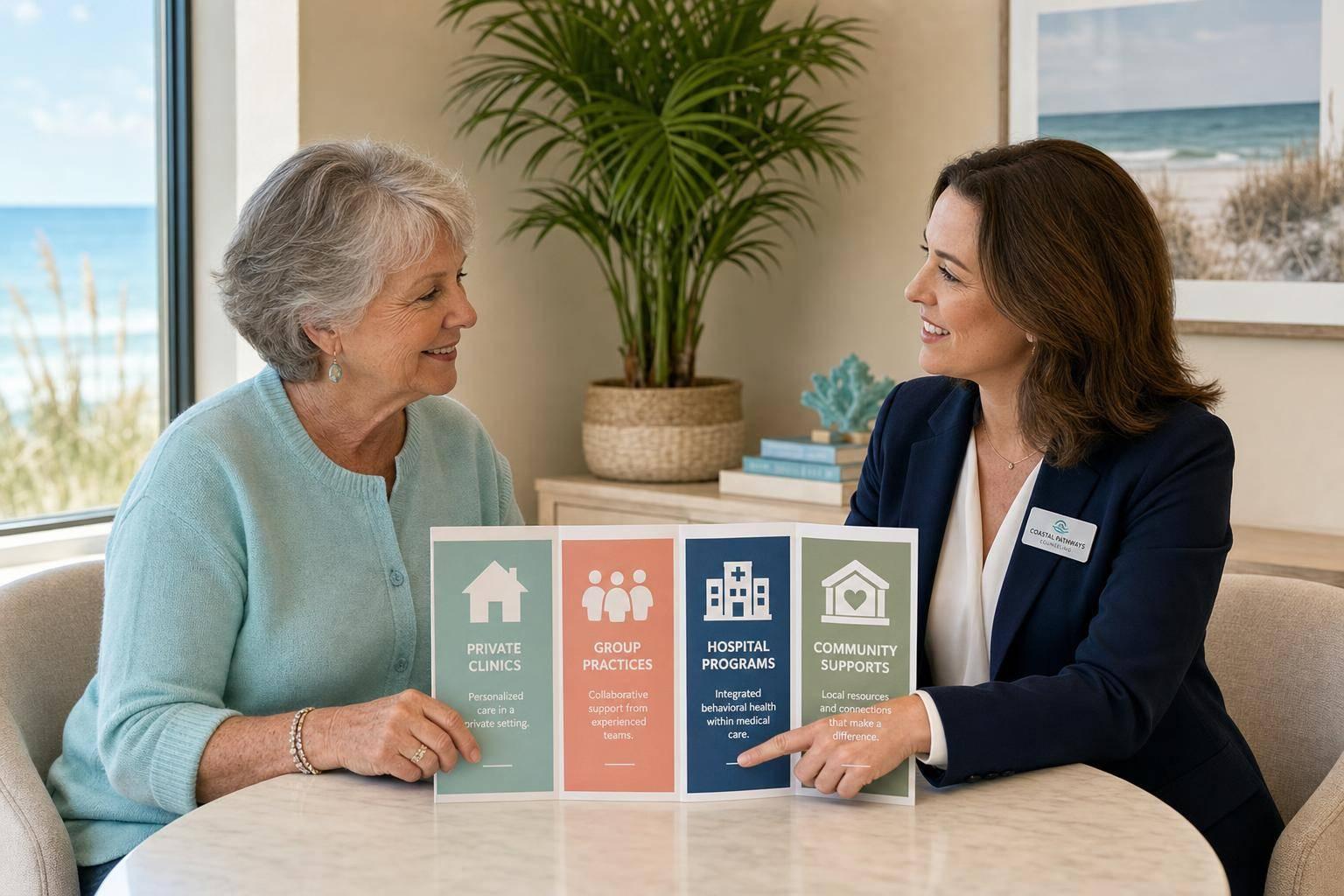
If you’re helping an older adult in South Walton find mental health support, the first question is simple: How much care is needed right now? For mild grief, anxiety, or stress, I’d look at private therapy or a group practice first. For isolation or money strain, community programs may be enough to start. For suicidal thoughts, severe confusion, or psychosis, I’d skip routine scheduling and go straight to emergency or hospital care.
In this area, that choice matters even more because care is often spread across South Walton, Destin, Miramar Beach, and Panama City. Adults age 65 and older make up about 1 in 5 Walton County residents, and 43% of Americans age 60+ report loneliness. So the right setting is not just about symptoms. It’s also about drive time, Medicare, family help, and whether telehealth is an option.
Here’s the short version:
- Private outpatient clinics: best for one-on-one therapy for grief, depression, anxiety, caregiver stress, and illness-related stress
- Group practices: best when a senior may need therapy, medication support, family sessions, or a clinician change in one office
- Hospital-based programs: best for crisis care, safety concerns, severe depression, psychosis, or confusion tied to medical problems
- Nonprofit and community resources: best for social contact, case help, caregiver support, food, transportation, and low-cost guidance
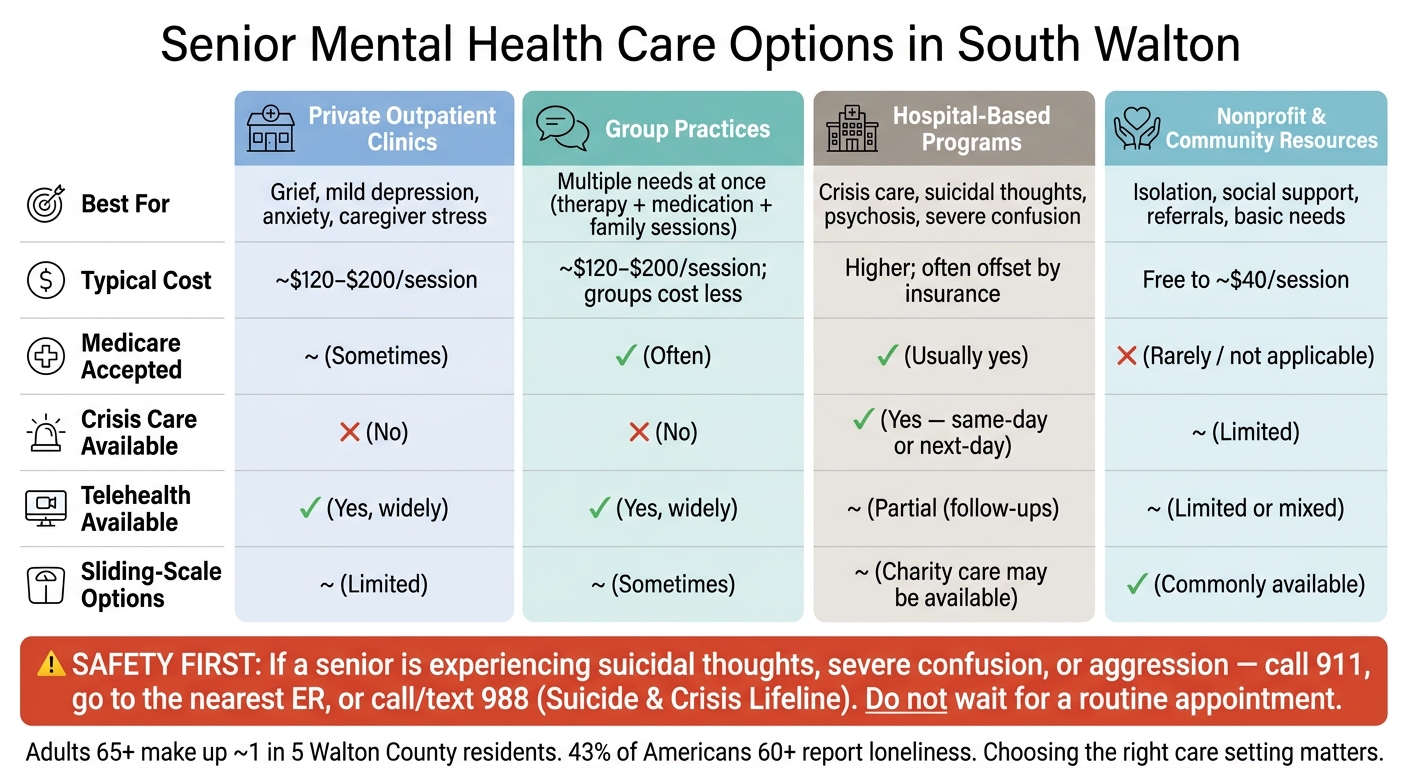
Senior Mental Health Care Options in South Walton: Quick Comparison Guide
Empowering Older Adults: The Rise of Specialized Counseling
sbb-itb-d06eda6
Quick Comparison
| Setting | Best for | Cost | Medicare | Crisis care |
|---|---|---|---|---|
| Private clinics | Mild to moderate mental health concerns | About $120–$200/session | Sometimes | No |
| Group practices | More than one need at once | About $120–$200/session; groups may cost less | Often | No |
| Hospital-based programs | Safety risk or severe symptoms | Higher, often insurance-based | Usually yes | Yes |
| Community resources | Isolation, support, referrals, basic needs | Often free to low-cost | Usually not billed that way | Limited |
What I like about this guide is that it helps you match the setting to the problem instead of treating every option the same. That makes it much easier to decide where to start - and when to step up care fast.
1. Private outpatient counseling clinics
Among the four settings in this guide, private outpatient clinics are the most direct match for lower-acuity concerns. These are office-based practices where a licensed therapist meets with clients weekly or every other week for 45 to 60 minutes at a time.
Best-Fit Concerns
This setting works well for grief, depression, anxiety, relocation stress, caregiver strain, or illness-related distress. It is not the right place for suicidal risk, hallucinations, delusions, or dementia-related agitation or unsafe behavior. Those cases need a higher level of care.
Level of Care
Of the four settings covered here, private outpatient counseling is the lowest-intensity one-on-one option. Care usually begins with a 60 to 90 minute intake session. That first visit often covers medical history, medications, memory and thinking, living situation, support system, and any recent losses.
After that, sessions usually center on evidence-based approaches such as cognitive behavioral therapy (CBT), interpersonal therapy, or problem-solving therapy. For older adults, therapists may adjust the pace and use larger-print materials so the work feels easier to follow. Progress is usually tracked through conversation and brief symptom scales, not daily medical check-ins.
Cost and Access
Medicare Part B covers 80% of the Medicare-approved amount for outpatient mental health care after the deductible. That said, not every private clinic accepts Medicare, so it's smart to check coverage before booking.
If someone pays out of pocket, rates often fall between $100 and $200 per session. Some practices also offer sliding-scale fees for seniors living on fixed incomes.
A few local examples:
- 30A Therapy, LLC has operated in South Walton since 2005.
- Life Navigation Counseling Services serves adults, adolescents, and older adults across Walton, Okaloosa, and Bay counties.
- Beach Blue Counseling in Santa Rosa Beach includes licensed clinical social workers and offers telehealth in Florida.
Telehealth can also make a big difference for seniors who want to avoid peak-season traffic on 30A.
When scheduling starts to get tricky, or when a senior needs help from more than one type of clinician, group practices are often the next step.
Family and Caregiver Support
With the senior's consent, some clinicians bring in a spouse or adult child to talk through communication, medications, safety, or care planning. Private clinics may also connect families with local senior centers, community programs, or other regional resources so support doesn't rest on one person alone.
When one clinician isn't enough, group practices can offer more specialties and easier scheduling.
2. Group practices and multi-provider therapy offices
A solo private clinic gives you one clinician. A group practice gives you a team.
These offices often bring licensed therapists, psychologists, psychiatric nurse practitioners, and sometimes case managers together in one place. They may also share intake, records, and billing. For seniors dealing with more than one issue at the same time, that kind of coordination can make a big difference. It gives this setting a clear step up from solo outpatient care.
Best-Fit Concerns
Group practices tend to work best when a senior needs more than one service or more than one clinician. They can be a good match for:
- Mild memory concerns or early cognitive changes
- Late-life relationship or family conflict
- Chronic illness adjustment
- Caregiver stress
There’s another plus here. If one clinician doesn’t feel like the right fit, a senior can often switch to someone else within the same practice instead of starting from scratch somewhere new.
Level of Care
Group practices offer moderate outpatient care. They usually have a broader mix of services than a solo clinic, but they’re still less intensive than hospital-based programs.
Common services include individual therapy, couples and family sessions, and education groups. Some practices also run groups focused on grief, chronic pain, or adjustment to retirement. Research backs this up: group therapy helps many older adults, and for many conditions, it’s considered as effective as individual therapy.
That setup can make care feel a lot smoother. A senior dealing with grief and sleep problems, for example, may start with therapy and then move to in-house medication support without changing offices.
Local options in South Walton include practices such as Lakeview Center of Walton County and 30A Therapy Associates, both of which offer individual and group counseling for adults and older adults.
Cost and Access
Group sessions usually cost less per person, and multi-provider offices often make it easier to change clinicians without restarting care.
Individual therapy sessions often run about $100–$200. Group sessions usually cost less per person because the fee is shared among participants. For seniors living on fixed incomes, it’s smart to ask whether lower-cost clinicians in the practice offer sliding-scale rates.
Family and Caregiver Support
These offices can also coordinate care for the senior and family members, with consent. For example, a group practice may assign one clinician to the older adult and another to a stressed adult child, then coordinate care between them.
Some offices also offer caregiver support groups on-site. That can help a lot when families are dealing with dementia or chronic illness from a distance. This kind of coordinated care can reduce caregiver burnout and make it more likely that a senior can safely age in place along the coast. When symptoms start to become unsafe, hospital-based programs offer the next level of care.
3. Hospital-based behavioral health programs
Hospital-based programs are meant for seniors whose symptoms call for 24-hour supervision or crisis stabilization. This level of care is often used when someone needs close medication monitoring or urgent help for issues like suicidal thoughts, psychosis, severe depression, or dementia-related confusion.
Best-Fit Concerns
Hospital care makes sense when safety is at risk, symptoms are severe, or a mental health condition needs to be watched alongside medical issues like heart disease, diabetes, or neurological problems.
Level of Care
Hospital programs often provide a step-by-step path of care. A senior may begin with inpatient stabilization, then move to a lower level of support as symptoms ease.
| Level | Structure | Best for |
|---|---|---|
| Inpatient | 24/7 care in a secure unit; stays may range from several days to a few weeks | Crisis stabilization, safety risks, severe symptoms |
| Partial Hospitalization (PHP) | Full-day treatment on weekdays, overnight at home | Needs intensive structure without overnight stay |
| Intensive Outpatient (IOP) | Several hours per week, less intensive | Step-down care, ongoing support with daily routines |
In this region, the main difference between programs comes down to how much supervision they offer and how smoothly they help patients move into step-down care. Options include HCA Florida Fort Walton-Destin Hospital for inpatient, PHP, and IOP services; HCA Florida West Hospital's Reflections unit, an inpatient geriatric behavioral health unit for adults 65 and older; and Emerald Coast Behavioral Hospital for geriatric psychiatry.
Cost and Access
Hospital care costs more than outpatient counseling, but Medicare can help. Part A covers medically necessary inpatient psychiatric stays, and Part B covers PHP and IOP. Hospitals also offer financial counseling before admission, which can make the process a little less stressful for families.
HCA Florida Fort Walton-Destin Hospital also offers a free, confidential phone screening to help families figure out whether inpatient care, PHP, or IOP is the right fit.
Family and Caregiver Support
These programs usually include family counseling, medication education, and discharge planning. They also help connect seniors with follow-up care, such as PHP, IOP, or other outpatient services, so support doesn't stop after the hospital stay.
4. Nonprofit and community-based support resources
For seniors who don't need clinical treatment, community programs can offer the next layer of help. They fill a key gap in South Walton's senior support network by giving older adults social contact and day-to-day help without putting them into a formal therapy setting. In most cases, this works best as a low-intensity first step or as backup alongside therapy.
Best-Fit Concerns
These resources tend to fit seniors dealing with social isolation, mild mood shifts, or everyday stress around bills, medications, and Medicare. Some programs focus more on connection. Others help with basic needs.
Coastal Seniors of South Walton (CSSW), for example, runs monthly programs on nutrition, exercise, health education, and legal topics. That can be a good fit for seniors who need regular contact and structure more than clinical care.
For seniors under financial strain, Caring & Sharing of South Walton offers food, clothing, and limited help with rent and utilities. It also provides counseling and case management for income-eligible Walton County residents.
Level of Care
These programs center on case management, resource navigation, wellness programs, and supportive counseling, not psychotherapy or medication management. So they are best used for support and referrals, not higher-level treatment.
One group stands out here because it does offer clinical care: Lakeview Center of Walton County provides outpatient counseling, psychiatric care, crisis counseling, case management, and wellness programs for all ages, including seniors.
NWFLAAA plays a different role. It acts as a referral hub, helping adults age 60 and older connect with services and helping families sort through their options.
Cost and Access
Cost is often one of the biggest draws. These services are usually low-cost or free. CSSW memberships start at about $30 per year, and many NWFLAAA services are free.
The Florida Elder Helpline (1-800-963-5337) can connect callers with local counseling, caregiver support, and transportation. The Emerald Coast Council on Aging (ECCOA) also offers non-medical in-home support, meal delivery, and transportation help so older adults can stay independent and reduce isolation.
Family and Caregiver Support
Caregivers are part of this picture too. NWFLAAA gives out caregiver toolkits with practical guides, referrals to respite programs, and phone consultations to help families make long-term care decisions.
NAMI adds free, peer-led support through Family Support Groups and Family-to-Family education. And 2-1-1 in Walton County offers 24/7 crisis access for people at risk of suicide.
The tradeoff is pretty simple: these services are often easier to reach, but most are not a substitute for formal therapy.
Cost, Access, and Practical Tradeoffs Across Settings
Choosing a setting usually comes down to three things: cost, access, and how severe the symptoms are. The main question isn't which option is "best." It's which one fits the situation.
Private clinics and group practices often cost more than community-based options, but they give the most direct path to outpatient care. Medicare can make treatment easier to afford, though acceptance still depends on the provider. Hospitals are the most likely to take Medicare, while private clinics are less consistent.
The table below breaks those differences into a simple decision guide.
| Factor | Private Clinics | Group Practices | Hospital-Based Programs | Nonprofit/Community |
|---|---|---|---|---|
| Typical cost | About $120–$200/session | About $120–$200/session; varies by provider and insurance | Similar or higher billed rates; more often offset by insurance | Often $0–$40/session or free |
| Medicare acceptance | Sometimes | Often | Usually yes | Rarely / not applicable |
| Sliding-scale options | Limited | Sometimes | Charity care may be available | Commonly available |
| Referral required | No | No | Sometimes, depending on service | No |
| Wait times | Often 1–2 weeks for non-urgent visits | Moderate | Longer for routine outpatient care; faster for urgent evaluation | Minimal to none |
| Telehealth available | Yes, widely | Yes, widely | Partial, especially for follow-ups | Limited or mixed |
| Crisis access | No | No | Yes - same-day or next-day evaluation | Limited |
| Transportation burden | Moderate | Moderate | Higher; may require travel to Destin or Panama City | Lower |
Those differences show up in day-to-day life pretty fast. Along the 30A corridor, access can be a real hurdle. Hospital-based behavioral health programs and some larger group practices may be in nearby cities, which can mean long drives. During peak tourist season, traffic on 30A can turn a simple appointment into a much bigger chore. Telehealth through private clinics or group practices avoids that problem and lets seniors attend visits from home.
For seniors without solid coverage, sliding-scale community programs are often the lowest-cost place to start.
Best-Fit Concerns
Grief, retirement stress, and mild anxiety often fit well in private clinics or group practices. Chronic illness adjustment may call for outpatient care with closer coordination or hospital-linked support. Caregiver strain and family conflict tend to fit group practices or caregiver support groups. Suicidal thoughts, severe confusion, or psychosis call for hospital evaluation.
Level of Care
As symptoms get worse, the level of care should rise too. Low-intensity support may start with nonprofit programs. Stable symptoms often fit outpatient therapy. Safety risks or fast decline point to hospital care.
Cost and Access
For Medicare beneficiaries, enrolled outpatient or hospital programs usually offer the best value. For uninsured or underinsured seniors, nonprofit services and sliding-scale programs are often the most affordable way in.
Family and Caregiver Support
Family involvement also looks different across settings. Private clinics usually bring family members in session by session. Group practices may offer more structured family work. Hospitals often focus on discharge planning. Community programs tend to help caregivers through peer groups and referrals. Families should ask how they can take part in care.
Pros and Cons of Each Setting
Once cost and access are clear, the next step is simpler: look at what each setting offers, and what it gives up.
There’s no perfect option here. Each one has clear strengths and tradeoffs. In South Walton, practical stuff matters too. Drive time, traffic, and telehealth access can shape the best choice just as much as clinical fit.
Private clinics often work well when continuity matters most. A senior can keep seeing the same therapist over time, which can make care feel more steady and familiar. The downside is cost, and these offices usually have limited crisis capacity. They aren’t set up for emergencies, and out-of-pocket spending can climb if Medicare isn’t accepted.
Group practices can make it easier to find an open provider. They also give families a way to stay within one office if a change is needed, which can save time and reduce stress. The tradeoff is consistency. If staff turnover happens, continuity can slip, and a senior may need to switch providers.
Hospital-based programs are the best match for crisis care. That’s where they shine. The catch is that care is usually short-term and built around stabilization, not long-term therapy.
Nonprofit and community resources are often the lowest-cost way to get started. For some families, that alone makes them worth a close look. But support may be lower in intensity, and availability can vary based on funding and staffing. The table below shows those tradeoffs side by side.
| Setting | Key Pros | Key Cons |
|---|---|---|
| Private clinics | Consistent therapist; flexible scheduling; telehealth available | Higher out-of-pocket cost; Medicare not accepted by every provider; no crisis capacity |
| Group practices | Several providers in one office; easier to stay in care if a change is needed | Provider turnover disrupts continuity; fewer sliding-scale options |
| Hospital-based programs | Built for crisis care; integrated medical and psychiatric teams | Short-term stabilization only; less personalized; higher cost |
| Nonprofit/community | Low or no cost; reduces isolation; accessible without referral | Lower intensity; availability depends on funding and staffing |
For South Walton seniors, the best fit usually comes down to symptom severity, transportation, and how much day-to-day support the family can provide.
Conclusion
The right choice depends on need, cost, and urgency. Private outpatient clinics work well for ongoing one-on-one therapy for grief, mild depression, anxiety, or retirement adjustment. Group practices make sense for seniors who need therapy along with medication support or family involvement. Hospital-based programs are meant for care that needs to step up when safety becomes the immediate issue, not for routine appointments. Nonprofit and community resources can offer low- or no-cost support, social connection, and help with referrals.
Care doesn't always happen in just one place. Therapy, support groups, and post-hospital care can all work together. A senior may move between settings as needs change, and sometimes more than one setting is used at the same time. In plain terms, care can overlap.
One exception comes before every other option: safety risk. If a senior is experiencing suicidal thoughts, severe confusion, aggression, or inability to care for basic needs, don't wait for an appointment. Call 911, go to the nearest emergency department, or contact the 988 Suicide & Crisis Lifeline by calling or texting 988. Use emergency services first, not a routine appointment.
FAQs
How do I know which care setting to start with?
Start by figuring out what the person actually needs day to day and how much help makes sense. That includes physical ability, use of medical equipment, and any chronic conditions that may shape care.
A simple resource binder can make this much easier. It can include:
- Medical history
- Provider contact information
- Questions for specialists
That kind of information helps narrow down the best fit.
From there, look for providers that line up with those needs, whether that means accessibility, one-on-one support, or medical know-how. In more complex cases, a mix of services can give you more room to build care that fits the person, not the other way around.
Will Medicare cover senior counseling in South Walton?
Yes, Medicare may cover senior counseling in South Walton through some local providers. Bridgeway Health Clinics clearly states that it accepts Medicare for behavioral health services.
Other clinics, such as Walton Community Health Center, may also provide behavioral health support and offer sliding fee scales if your coverage is limited. Insurance rules can change from one facility to another, so it’s smart to confirm Medicare acceptance when you schedule.
When should a senior go to the hospital instead of therapy?
A senior should go to the hospital, not therapy, when they need emergency care, trauma treatment, or a level of clinical support that goes beyond standard outpatient counseling or general wellness services.
Hospitals are the right choice during an acute medical crisis, when intensive diagnostic testing is needed, when surgery may be required, or when there’s a sudden and severe drop in health that calls for 24-hour observation. A primary care physician can help decide whether an emergency evaluation is needed.