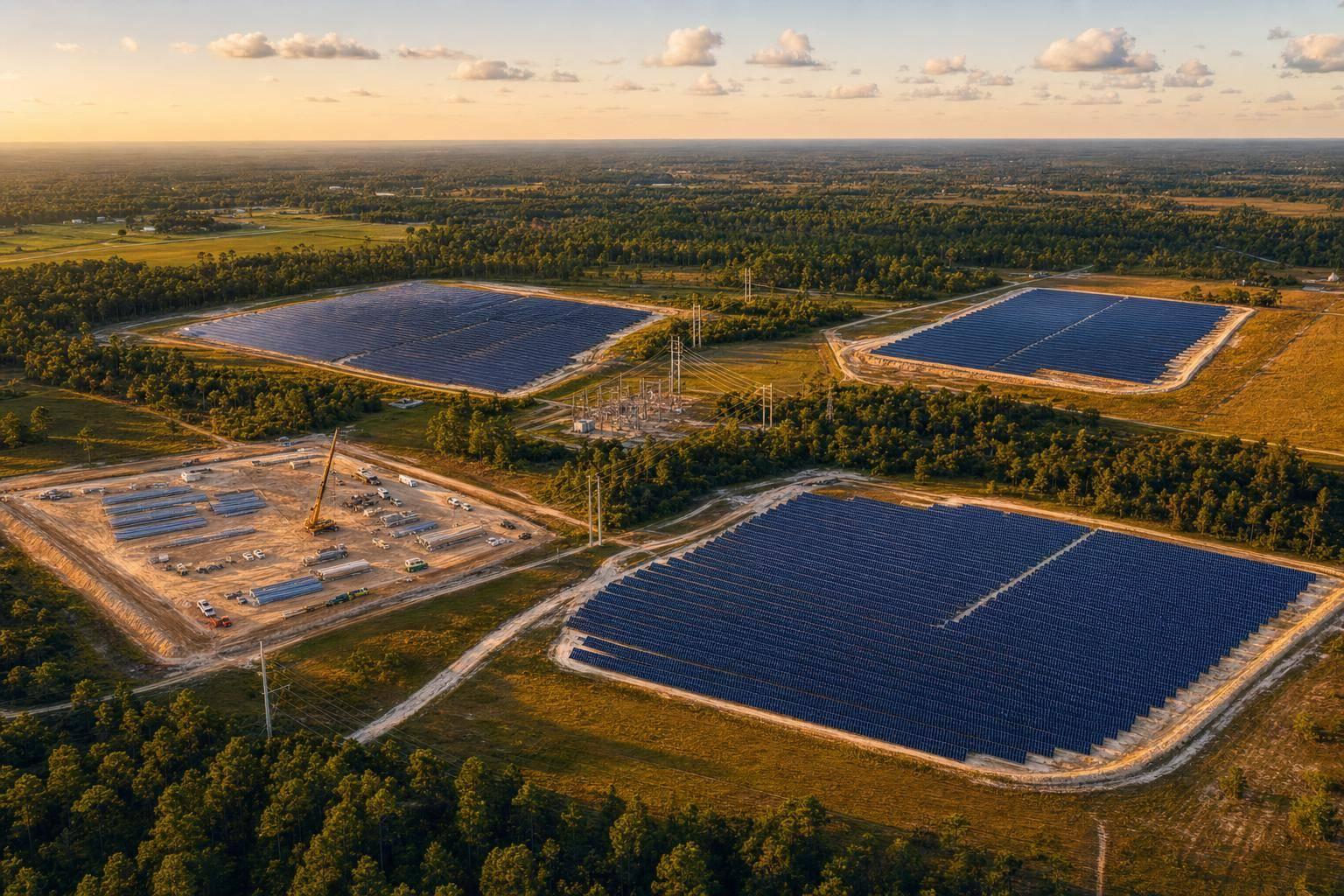
Three FPL solar sites are shaping north Walton County right now: two are live, and one is being built. If you live in South Walton or near 30A, the change is mostly offsite, but the power still feeds into the same grid you use.
Here’s the short version:
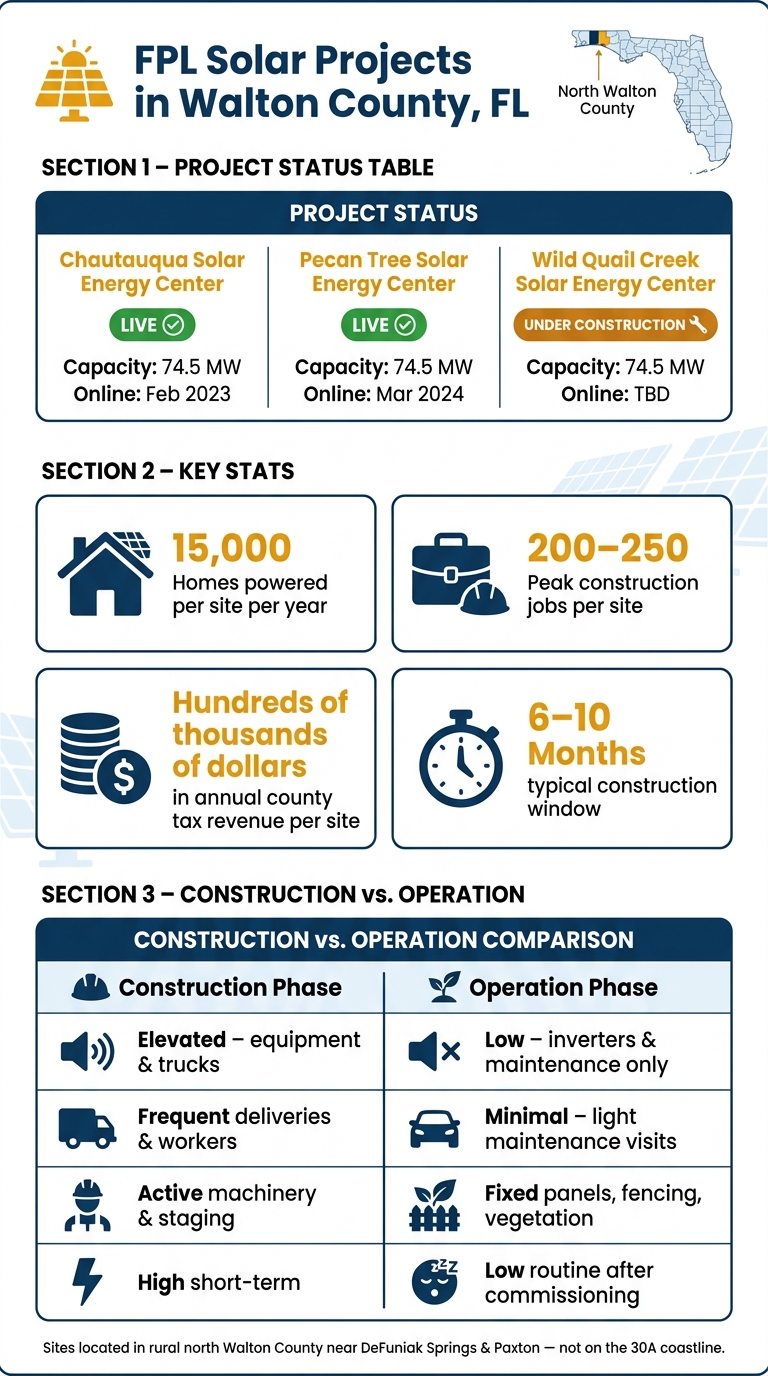
- Chautauqua Solar Energy Center went online in February 2023
- Pecan Tree Solar Energy Center went online in March 2024
- Wild Quail Creek Solar Energy Center is under construction
- Each site is 74.5 megawatts
- Each site can power about 15,000 homes per year
- Build time is often about 6 to 10 months
- FPL says each site can bring 200 to 250 construction jobs
- FPL also says each site can add hundreds of thousands of dollars per year in local tax revenue
If you want the plain-English takeaway, it’s this: the main local impact is short-term construction traffic and noise in rural north Walton County, followed by a quiet, low-traffic power site. These projects use large inland parcels near Paxton and DeFuniak Springs, not coastal land along 30A.
| Project | Status | Capacity | Year online |
|---|---|---|---|
| Chautauqua | Live | 74.5 MW | February 2023 |
| Pecan Tree | Live | 74.5 MW | March 2024 |
| Wild Quail Creek | Under construction | 74.5 MW | TBD |
I’d sum it up this way: these projects are big on acreage, modest in daily activity once built, and mostly matter to coastal residents through grid supply rather than direct neighborhood change.
FPL Walton County Solar Projects: Key Facts & Community Impact
FPL submitted proposal for solar farms
sbb-itb-d06eda6
Which FPL Solar Projects Are in Walton County
Walton County has three FPL utility-scale solar sites: Chautauqua, Pecan Tree, and Wild Quail. In later project updates, Wild Quail appears as Wild Quail Creek.
| Project | Status | Capacity | Year Online |
|---|---|---|---|
| Chautauqua Solar Energy Center | Operating | 74.5 MW | Feb. 2023 |
| Pecan Tree Solar Energy Center | Operating | 74.5 MW | 2024 |
| Wild Quail Creek Solar Energy Center | Under construction | 74.5 MW | TBD |
Wild Quail is listed as Wild Quail Creek in later construction updates.
Next, we’ll look at where each project sits and what the build timeline can mean for nearby residents.
What a Utility-Scale Solar Energy Center Includes
A utility-scale solar energy center is a large power plant that sends electricity to the regional grid. In plain English, it’s not a small rooftop setup. It’s a full site built to feed power into the broader system people use every day.
Chautauqua, for instance, spans about 867 to 900 acres, with roughly 400 acres used for panel arrays. Sites like Chautauqua also include panel arrays, inverters, transformers, a substation tie-in, fencing, access roads, and stormwater ponds.
What Project Size Means in Plain Terms
Each Walton County FPL site is rated at 74.5 MW. That’s enough to power about 15,000 homes each year.
Where the Projects Are Located and How the Timeline Works
Once you look at project size and power output, the next thing people want to know is simple: Where are these sites, and what does construction look like on the ground?
FPL's Walton County solar sites are in rural inland areas near DeFuniak Springs and Paxton. The Chautauqua Solar Energy Center is at 3650 Brown Road in DeFuniak Springs. The Pecan Tree Solar Energy Center was proposed on about 762 acres between E.M. White Road and Davis Road along County Road 0605, south of Paxton and east of U.S. 331.
For readers in South Walton and along 30A, that means the main effect is indirect. The building happens inland first. The grid support shows up later.
FPL maps out sites years in advance through its Ten-Year Power Plant Site Plan. After that, projects move through permitting, studies, and design before any building begins. That lead time can stretch when local review adds more steps. In Pecan Tree's case, Walton County's technical review approved the development order on the condition that a flood elevation study be completed.
At first, most of the action is on paper, not on the site itself. During planning and permitting, residents might notice survey crews on rural land or public notices tied to hearings, but not much heavy equipment yet.
Once approval is done, the project becomes far more visible. Trucks and construction equipment start using nearby county roads. Then come the main build stages: grading, racking, and solar panel installation. That work can run for months before the site moves into testing.
The construction window is usually pretty predictable. A solar project of this size often takes about six to ten months to build. After that comes a shorter testing and grid-connection period, often several weeks, while FPL checks electrical systems and protective relays before the plant goes online.
So the noisy part doesn't last all that long. Heavy traffic tends to drop once panel installation wraps up and testing begins. From there, the site shifts into long-term operation with much less day-to-day activity.
Of course, schedules can still move around. Weather, permitting, equipment delivery, and substation work can all affect timing. Pecan Tree Solar Energy Center, for example, is listed as operational as of March 1, 2024, with 74.5 MW of rated capacity.
Community Benefits, Land Use, and Day-to-Day Impact
How Solar Projects Can Benefit the Local Community
For Walton County, the big issue is simple: what do these projects mean for jobs, land use, and everyday life?
Once a solar site starts operating, the county keeps getting long-term returns. FPL says each solar center generates hundreds of thousands of dollars in annual tax revenue for Walton County, which helps fund schools, public safety, and infrastructure. That revenue continues even after construction wraps up, and it comes with a very different land-use pattern and a much lighter day-to-day presence.
During construction, a project can support 200 to 250 peak construction jobs and bring short-term spending to local businesses. After that, staffing drops sharply. The site needs only limited personnel to operate, but the county still receives the tax revenue.
Land Use and the Surrounding Area
A solar site uses large rural parcels in north Walton County, but it keeps that land open and vegetated instead of turning it into a fully paved, built-out property. FPL says it uses buffers and setbacks to help protect rural views.
Site plans also account for Florida’s heavy rain. Stormwater features such as swales, retention ponds, and graded drainage are built into the design to manage runoff. Vegetation is usually kept low, and some sites may include pollinator-friendly plantings. That helps with drainage and can also provide some habitat value.
At bottom, the tradeoff is open land versus a built-up site.
| Topic | Utility-Scale Solar Site | More Intensive Development |
|---|---|---|
| Land-use pressure | Keeps land open; uses large contiguous parcels | Replaces open land with buildings and pavement |
| Traffic | Low after construction; mostly maintenance trips | More daily traffic |
| Emissions | No direct on-site air emissions during operation | Ongoing vehicle-related emissions |
| Public-service demand | Minimal once operating | Greater demand for roads, utilities, schools, and emergency services |
| Open-space character | Generally retains a vegetated, open appearance | More likely to convert land into built-up, impervious uses |
What to Expect Once the Sites Are Open
Once operating, solar energy centers tend to be quiet, low-traffic sites that produce power without dust, emissions, or adverse effects on adjacent communities or farms. There’s no daily workforce coming and going, no customer traffic, and no heavy industrial noise.
The routine sounds are limited. In practice, that usually means inverter noise, tracking motors, and the occasional maintenance vehicle.
| Phase | Noise | Traffic | Visibility | Site Activity |
|---|---|---|---|---|
| Construction | Elevated from equipment and trucks | Frequent deliveries and worker vehicles | Active machinery, staging, soil disturbance | High short-term activity |
| Operation | Low; mainly inverters and occasional maintenance | Minimal; mostly light-duty maintenance visits | Fixed panels and fencing; routine vegetation management | Low routine activity after commissioning |
For nearby residents, the main effect is usually temporary construction activity first, then a low-profile operating site after that. In plain English, the busiest period is up front. Once the project is online, the site tends to fade into the background of daily life.
Conclusion: Key facts to keep in mind
The main points to remember
FPL's Walton County solar buildout is one piece of a larger solar push across Florida. Chautauqua went live in February 2023, and projects like Pecan Tree and Wild Quail follow much the same 74–75 MW size pattern.
That size helps explain why the construction schedule matters. These projects go through planning, permitting, construction, and then long-term operation. The noisy, disruptive part is the buildout. Once a site is up and running, on-site activity drops off fast.
Each facility can power about 15,000 homes per year and add hundreds of thousands of dollars in yearly tax revenue for Walton County. But those gains don't mean direct bill cuts for every customer. They show up more in cleaner power on the grid and added county revenue. For those looking to choose a 30A neighborhood, the effect is mostly tied to the power system, not the coastline.
The sites are in rural north Walton County, inland from 30A. So for coastal residents and visitors, the impact is mostly indirect.
FAQs
Will these projects lower my electric bill?
The available information does not confirm whether Florida Power & Light's solar projects will lower individual electric bills for Walton County residents.
Current Walton County materials focus on infrastructure and community-funded projects, not utility bill impacts. For details about your energy costs, contact Florida Power & Light directly.
How close are the solar sites to 30A and South Walton?
The available information does not say how close Florida Power & Light solar projects are to 30A or South Walton.
For broader context on land use, conservation, and development in the area, sowal.co covers South Walton and the 30A coastline.
What changes should nearby residents expect during construction?
Nearby residents should expect some temporary noise and the presence of heavy machinery during construction. In most cases, work is limited to daylight hours to help cut down on disruption, and temporary pipelines or other equipment may be visible on-site.
The good news is that construction often moves fast. Developers also tend to use measures like sand bridges to keep access open to shared areas or beaches. For the latest details, residents can follow official updates.