
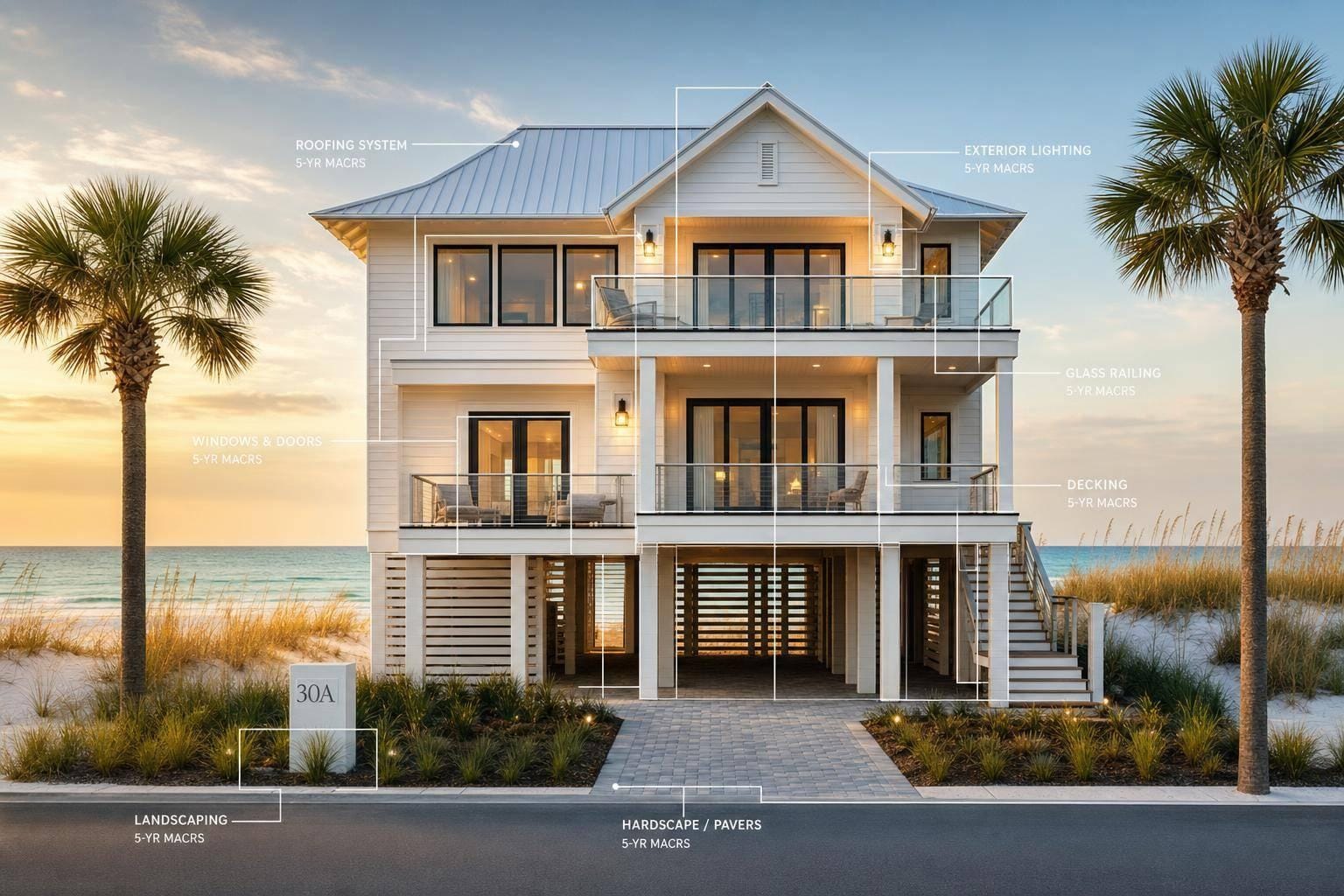
If you own a 30A rental, a cost segregation study can shift part of your property from 27.5-year depreciation into 5-, 7-, or 15-year property and create a much larger first-year deduction. In 2026, that matters even more because many reclassified assets placed in service during the year may qualify for 100% bonus depreciation, while some older contracts may still fall under a 20% rate.
Here’s the short version: I’d look at three things first - your depreciable basis, your placed-in-service date, and whether you can use the loss under passive activity and material participation rules. On a rental with $1,000,000+ of depreciable basis, pools, outdoor features, or high-end build-outs, the tax impact can be large. But if you plan to sell in 2 to 3 years, have low income, or can’t use passive losses, the math may not work.
What this guide covers:
- How cost segregation changes the timing of depreciation
- Which parts of a 30A rental may move into 5-, 7-, or 15-year classes
- How 2026 bonus depreciation works based on acquisition and placed-in-service timing
- When short-term rental losses may offset other income
- Who should order a study, and who may want to skip it
- What records your CPA will need before filing
A simple example from the article shows the idea: on a $1,200,000 purchase with a 40/60 land-to-building split, only $720,000 is depreciable under the base method, or about $26,182 per year. If a study reclassifies $270,000 into shorter-life assets, your first-year deduction can jump fast, depending on your 2026 bonus rate and tax profile.
Quick comparison:
| Topic | What to know |
|---|---|
| Standard rental depreciation | Residential rental building: 27.5 years |
| Assets often reclassified | 5-, 7-, and 15-year property |
| 2026 bonus depreciation | Often 100% for qualifying property acquired after 01/19/2025 and placed in service in 2026; some older deals may be 20% |
| Best fit | High-basis rentals, major upgrades, owners who can use losses |
| Weak fit | Small basis, short hold, passive losses you can’t use |
| Key filing support | Cost seg report, invoices, photos, permits, Form 4562 data |
If I were reviewing this for 2026, I’d treat cost segregation as a timing play with strict record rules, not an automatic win. The upside can be large, but only if the property facts, tax rules, and filing support all line up.
How Cost Segregation Works for Short Term Rentals (and When It Makes Sense)
sbb-itb-d06eda6
Cost Segregation Basics
A cost segregation study breaks a building into parts and moves certain costs into shorter depreciation buckets. For 30A rentals with pools, outdoor kitchens, and high-end finishes, that shift can be big. In plain English: instead of keeping most of the property in the 27.5-year bucket, the study may move part of the basis into 5-, 7-, or 15-year property, which can front-load deductions. The big issue is simple: which parts of a 30A rental can leave the 27.5-year recovery period?
How Depreciation Works for Residential Rentals
Under MACRS, residential rental buildings are depreciated on a straight-line basis over 27.5 years, starting when the property is placed in service. Land is never depreciable. Only the building and qualifying improvements count.
Here’s the baseline. On a $1,200,000 purchase with a 40/60 land-to-building split, the land portion is $480,000, and that amount gets no depreciation. The depreciable building basis is $720,000, which comes out to about $26,182 per year under the standard 27.5-year schedule.
That’s what a cost segregation study tries to improve on.
Which Components Can Be Accelerated
The IRS draws a line between the core building and items that function more like personal property or site improvements. The core structure stays on the 27.5-year schedule. Think foundation, framing, load-bearing walls, roof, main plumbing, and HVAC systems. Other items can often be moved into shorter lives. That tends to matter a lot for beach rentals with furnished interiors, outdoor features, and site work.
Industry data says cost segregation studies often move 20% to 30% of a residential property’s basis into shorter-life asset classes, and some properties get to 40%. For a high-value 30A rental with upscale finishes, outdoor amenities, and dedicated electrical work, that can add up fast.
Here’s where those shifts usually happen:
| Recovery Period | Common 30A Examples | Cost Segregation Treatment |
|---|---|---|
| 5-year property | Appliances, carpet/LVP flooring, removable cabinets, decorative lighting, dedicated audio-visual wiring, hot tub wiring, ceiling fans | Reclassified as tangible personal property |
| 7-year property | Certain specialty equipment and fixtures | May be classified as longer-lived personal property |
| 15-year land improvements | Parking pads, driveways, patios, fencing, irrigation systems, outdoor lighting, nonstructural walkways | Reclassified as land improvements, separate from building |
| 27.5-year structural building | Foundation, framing, roof, load-bearing walls, main electrical, built-in plumbing and HVAC systems | Remains residential rental real property; not reclassified |
| Nondepreciable land | Lot, natural sand, underlying land value | Never depreciated |
A residential condo study shows how detailed this can get. Reclassified items included decorative lighting, granite and marble countertops, dedicated duplex outlets, and kitchen appliances - all moved out of the 27.5-year building category. For a 30A property, the same kind of review may also pick up outdoor kitchens, pool equipment, and boardwalks when they’re separately documented.
Once those assets are moved into shorter-life classes, the next piece is bonus depreciation.
How Bonus Depreciation Applies to Reclassified Assets
When a study properly reclassifies components into 5-, 7-, or 15-year property, those assets may also qualify for first-year bonus depreciation under 2026 federal rules. Bonus depreciation applies to eligible property with a recovery period of 20 years or less, which covers all three of those shorter-life categories.
Using the $1,200,000 example above, suppose the study moves $180,000 into 5-year property and $90,000 into 15-year land improvements. That creates $270,000 of shorter-life property. Depending on the 2026 bonus percentage and when the property is placed in service, the owner may be able to apply bonus depreciation to part of that amount in year one.
The remaining $450,000 of structural building basis would still be depreciated at about $16,364 per year. The 27.5-year building itself does not qualify for bonus depreciation. And in 2026, the bonus rate depends on current federal law.
2026 Bonus Depreciation Rules and 30A Short-Term Rental Use
Placed-in-Service Timing Under 2026 Rules
The bonus depreciation rate for reclassified components depends on when those assets are placed in service, not when you close on the property.
Under the federal rules in effect for 2026, qualifying property acquired after January 19, 2025, and placed in service during 2026 is generally eligible for 100% first-year bonus depreciation. If the property was acquired under a binding contract before that cutoff, it may fall under the older phase-down schedule instead. In that case, 2026 bonus depreciation may be limited to 20%.
The placed-in-service date is the point when the property is ready and available for guests. That usually means permits are complete, furnishings are in place, and the listing is live at fair market rates. To support that date, keep records like:
- inspection sign-off
- delivery receipts
- a screenshot showing the live listing
Once the timing is set, the next step is figuring out whether the property is treated as a rental or as personal-use housing.
When a 30A Short-Term Rental May Support This Strategy
30A’s short-stay rental pattern can support income-producing treatment when the property is rented at fair market rates and personal use stays limited. The IRS treats a dwelling as a personal residence if personal use is more than the greater of 14 days or 10% of rental days during the year.
Staying under that limit helps you avoid vacation-home treatment, which can restrict deductions. If personal use is heavy, the home may fall into vacation-home treatment and lose some deduction flexibility.
If the property qualifies as a rental, the next issue is whether the owner’s level of involvement makes the loss usable in 2026.
Material Participation and Loss-Use Limits
Bonus depreciation can create a big first-year loss, but passive-activity rules decide whether that loss can offset wages or other active income.
For short-term rentals with an average guest stay of 7 days or fewer, the activity may be treated more like an operating business than a standard long-term rental. When that happens, material participation becomes the key test.
If you can show that you participated in the rental activity for more than 500 hours during the year, the losses may be treated as non-passive and offset other income. The same may apply if you worked more than 100 hours and no other person, including a property manager, participated more than you.
A self-managing owner with 650 documented hours may be able to use the loss against active income. On the flip side, full-service management often leaves the loss passive, which means it gets carried forward.
Self-managing owners with solid hour logs tend to have the strongest case for non-passive treatment. Full-service management usually points the other way.
From here, the decision comes down to whether the study cost makes sense for your property and tax situation.
Who Qualifies for a Study and When It Makes Sense
Cost Segregation for 30A Rentals: Should You Order a Study in 2026?
Owners Most Likely to Benefit
Once you know the loss is usable, the next step is simple: is the property big enough for the study to pay off?
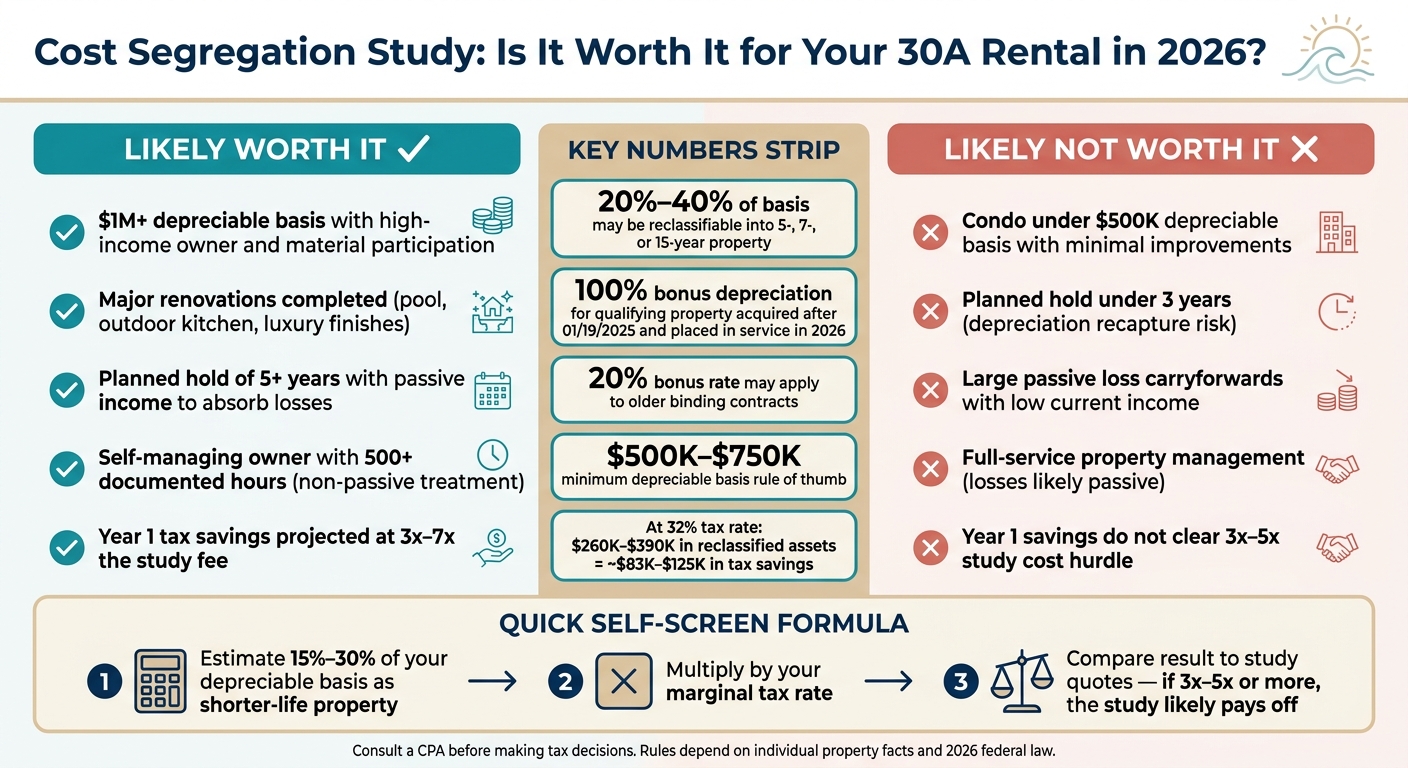
For high-basis 30A homes with pools, outdoor kitchens, and major upgrades, the answer is often yes. The best fit is usually an owner who recently bought or heavily renovated a 30A rental and has enough depreciable basis to make the math work. In practice, many practitioners use a rough cutoff of $500,000 to $750,000 in depreciable basis as the point where a formal study starts to make sense for residential investment property.
Here’s why. A property with $1.3 million in depreciable basis could produce about $260,000 to $390,000 in first-year deductions if 20% to 30% of that basis is moved into shorter-life categories. At a 32% tax rate, that works out to around $83,000 to $125,000 in tax savings.
But property value alone doesn’t decide it. Your tax profile matters just as much. The study helps most when the reclassified assets can create a deduction you can actually use in 2026. That usually points to high-income owners who can use the loss that year, or owners with enough passive income to absorb it.
Major capital improvements can tip the scales too. A pool, luxury kitchen, or outdoor living area may increase the amount that can be separated into shorter-life property under the 2026 rules.
That’s the money side of the test. After that, the big question is whether the study fee eats up too much of the upside.
When the Numbers May Not Justify the Study
Some cases are weaker from the start. Smaller properties with a lower depreciable basis - say, a condo bought for $400,000 with only modest improvements - may not have enough reclassifiable parts to justify the cost of the study.
A common rule of thumb is that the Year 1 tax savings should be at least 3x to 5x the study fee. Some advisors aim for 7x as a stricter hurdle. If you don’t get close to that range, the study often doesn’t earn its keep.
Use this quick screen:
| Situation | Study Likely Worth It? |
|---|---|
| $1M+ depreciable basis, high-income owner, material participation | Yes |
| Major renovations (pool, outdoor kitchen, luxury finishes) | Often yes |
| Planned hold of 5+ years, passive income to absorb losses | Yes |
| Condo under $500K basis, minimal improvements | Evaluate carefully |
| Hold under 3 years, recapture risk | Likely no |
| Large passive loss carryforwards, low current income | Likely no |
A short hold period is another warning sign. If you expect to sell in 2 to 3 years, depreciation recapture can wipe out a big chunk of the front-loaded tax gain. These studies tend to work better when the property will be held for 5 years or more.
The same issue comes up for owners who already have large passive loss carryforwards or face low current tax rates. In that case, a new study may just add more suspended losses without lowering the current-year tax bill.
A simple way to pressure-test the numbers is to estimate 15% to 30% of your depreciable basis as shorter-life property, multiply that by your marginal tax rate, and compare the result with quotes from engineering firms. If that number is 3x to 5x the study cost and you can use the loss in 2026, the case looks strong. If not, it may be smarter to pass.
If the math checks out, the next move is timing the study and pulling together the records before you file.
Timing, Records, Filing Points, and Key Takeaways
Once the numbers work, timing and recordkeeping decide whether the deduction holds up when you file.
When to Order the Study and What Documents to Collect
Order the study as soon as the property is ready to rent or the renovation is finished, and before filing the first return that claims depreciation. If you miss that timing, you may need Form 3115, and bonus depreciation is tied to the asset’s original placed-in-service year.
The paperwork you need changes based on where the project stands:
| Phase | Core Documents | Practical Note |
|---|---|---|
| Before purchase | Photos, inspection reports, preliminary renovation budgets, pro formas | Flag high-value improvements early |
| At closing | Settlement statement, purchase agreement, land/building allocation, appraisal | Share digital copies with your CPA |
| During renovation | Contractor invoices, contracts, permits, change orders, dated progress photos | Track which tax year each phase completes |
| At tax filing | Cost segregation report, fixed-asset schedule, prior depreciation records, Form 4562 | Confirm each asset bucket is classified correctly |
These records back up the depreciation entries reported on the return. For 30A properties with custom outdoor work, labeled invoices and site plans make it easier to separate 15-year land improvements from the building shell and land.
Where Cost Segregation Shows Up on the Tax Return
After the paperwork is in order, the next step is knowing where the deduction shows up on the return. Form 4562 is the main federal form used for depreciation and amortization.
After a cost segregation study, Form 4562 shows the reclassified asset buckets and any bonus depreciation claimed under Section 168(k). For individual owners, the deduction then flows to Schedule E.
Your CPA should also keep a fixed-asset schedule that lists each component, its recovery period, and its remaining life. It’s smart to ask your CPA to walk you through Form 4562 and that fixed-asset schedule after any year with a new study or a major renovation.
Key Points for South Walton Investors
For South Walton investors, the big issues are timing, documentation, and getting the asset classification right before filing. Short-term rentals with average stays of 7 days or fewer may be treated as a trade or business instead of a passive rental if you materially participate, which can let losses offset non-passive income directly. That call should be made before you commission the study, not after.
The IRS cost segregation audit guide specifically calls for site photographs and documentation supporting how costs were allocated. If you own a beach rental with a pool, outdoor kitchen, or other site work, you need a clean paper trail from purchase through the first booking.
FAQs
Is a cost segregation study worth it for my 30A rental?
Usually, yes. For many 30A rentals, a cost segregation study can improve after-tax cash flow by moving items like furnishings, kitchens, pools, and landscaping into shorter-life property groups.
That shift can lead to larger first-year deductions under current bonus depreciation rules. This tends to matter most for higher-bracket investors who meet IRS material participation rules for short-term rentals. Talk with your CPA about your tax situation and the chance of future depreciation recapture.
How do I know if I can use the loss in 2026?
In 2026, you can often use rental losses to offset W-2 income or other active income if your 30A property is treated as a short-term rental and you meet IRS material participation rules.
In plain English, that usually means the average guest stay is 7 days or less and you can show enough hands-on work during the year. A common path is at least 100 hours of participation and more time than anyone else involved.
If your property doesn't meet those rules, the loss will usually stay passive, which means it can offset only passive income.
What records do I need for a cost segregation study?
Gather records that support your property’s cost basis and construction history, including:
- Closing statements
- Appraisal reports
- Detailed invoices for major renovations
- Property tax bills
You’ll also want records that show placed-in-service dates and total costs. Those details support depreciation filings, including Form 4562 and Form 3115, and help back up your claims if the IRS audits you.
For more 30A buying, rental, and neighborhood context around investment properties, see our Real Estate Guide.