If I want the easiest family boat day on 30A, I start with a pontoon, check child-size life jackets, book more space than I think I need, and confirm the pickup point before I pay or use a South Walton itinerary generator to map out the rest of the day.
Most family rentals here run on calmer water like Choctawhatchee Bay, Destin Harbor, and Western Lake, which helps with comfort and first-time boating. For me, the short list is simple:
- Pick the right boat: pontoon for most families, tritoon for more space and a smoother ride, deck boat for more speed, captain if no one wants to drive
- Check safety first: life jackets for every rider, child sizes, swim ladder, fire extinguisher, horn, lights, and a safety talk
- Don’t book to the max: a 12-person limit can feel cramped once you add coolers, bags, and kids’ gear
- Look at comfort items: shade, dry storage, cooler space, and easy swim access
- Read the rules: operator age, Florida boating card rules, fuel, deposit holds, cancellation terms, and where you can take the boat
- Choose a close launch point: saving 1–2 hours of drive and parking time can make the day much easier
- Match the trip length to your group: 4 hours works for young kids; 8–9 hours fits bigger family groups with a slower pace
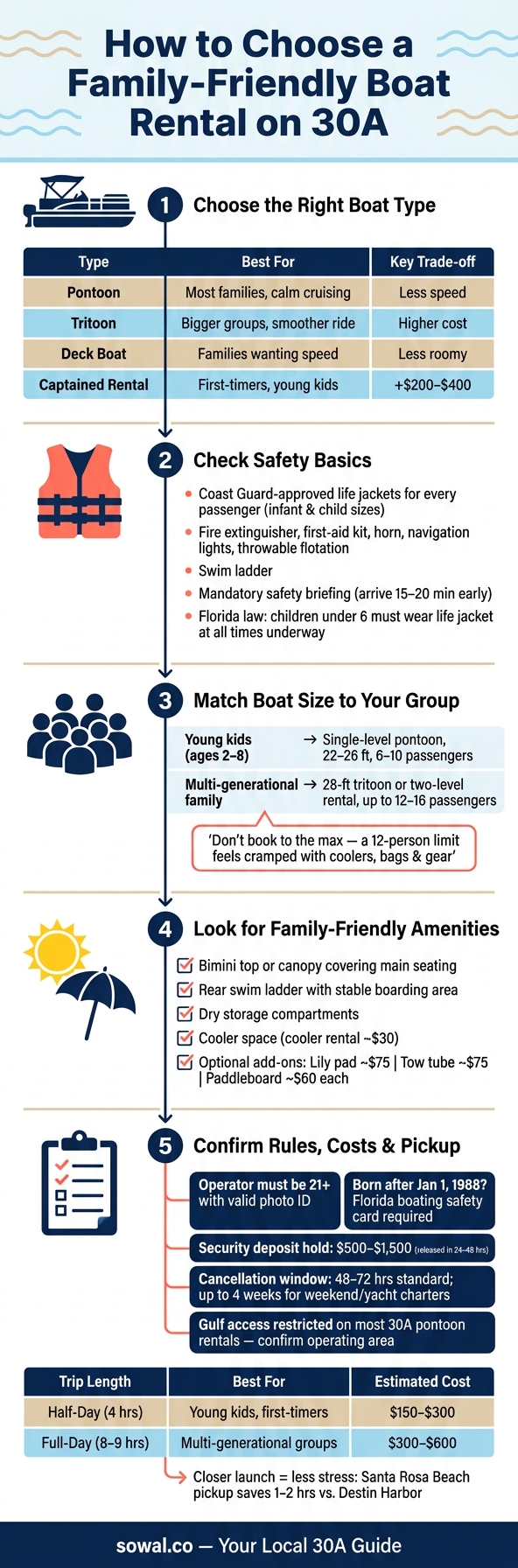
How to Choose a Family-Friendly Boat Rental on 30A: 5-Step Checklist
30a Pontoon Rental Santa Rosa Beach 30a Where Luxury meets the Water 850.220.6400
sbb-itb-d06eda6
Quick Comparison
| Option | Best for | Main trade-off |
|---|---|---|
| Pontoon | Most families, easy boarding, calm cruising | Less speed |
| Tritoon | Bigger groups, smoother ride, longer trips | Higher cost |
| Deck boat | Families who want a faster ride | Less roomy feel |
| Captained rental | First-timers, young kids, grandparents | Adds about $200–$400 |
I’d use this article as a booking checklist: boat type, safety gear, space, comfort, rules, then pickup.
Step 1: Choose the Right Boat Type
The boat you pick shapes the whole day. It affects stability, how easy it is to get on and off, and how much effort the outing takes.
Why Pontoon Boats Usually Work Best for Families
For most families on 30A, pontoons are usually the best fit because they’re stable, roomy, and easy to board. The open layout gives everyone more space to sit, stand, and move around. And swim ladders make it easier to keep an eye on kids and get in and out of the water without a struggle.
If you expect rougher water or want a longer cruise, a tritoon is often the better move. Tritoons ride smoother than standard pontoons, especially in rougher bay water, and they also run faster than standard rental pontoons.
When a Deck Boat or Captained Rental Makes More Sense
A deck boat works well for families who want a faster, sportier ride.
If nobody in your group wants to handle the boat, go with a captained rental instead. That option makes the day much more hands-off, which can be a big relief if you’d rather skip navigation and docking. It’s a strong pick for families with young children, grandparents, or first-time boaters.
Hiring a captain usually adds $200–$400 to the base rental cost. It also removes the need for the driver to have Florida’s boating safety card, which is required for anyone born on or after January 1, 1988 who operates a motorized vessel.
After you choose the boat type, check the safety gear before you book.
Step 2: Check Safety Basics Before You Book
Once you’ve picked a boat type, check the safety setup before you compare extras or price. A lower rate doesn’t mean much if the basics aren’t there.
Confirm Life Jackets, Swim Ladders, and Emergency Gear
Every boat rental on 30A should include U.S. Coast Guard-approved life jackets for every passenger, with infant and child sizes available so kids get the right fit. Before you head out, test each child’s jacket to make sure it fits well.
Also check for the standard emergency gear: a fire extinguisher, first-aid kit, horn, navigation lights, and throwable flotation. And don’t overlook the swim ladder. A sturdy ladder can make getting back on board much easier for kids and anyone who isn’t a strong swimmer.
Ask About the Safety Briefing and Florida Rules for Children
Plan to arrive 15 to 20 minutes early for the mandatory safety briefing. If you show up late, you’ll lose rental time. The briefing should walk you through the boat’s controls, life jackets, no-wake zones, and restricted areas.
Most pontoon rentals stay on Choctawhatchee Bay and coastal dune lakes.
Florida law also says that children under 6 must wear a U.S. Coast Guard-approved life jacket at all times while the vessel is underway.
After you’ve checked these safety basics, the next step is making sure the boat’s size and seating fit your group.
Step 3: Match Boat Size to Your Group
Count Passengers and Think Beyond the Posted Maximum
The posted limit tells you what's legal. It does not tell you what feels good for a family day on the water.
A 12-passenger boat can start to feel tight fast once you load in coolers, bags, toys, and a stroller. And yes, every person on board counts as a full passenger under the U.S. Coast Guard capacity rating, including infants and toddlers.
That extra deck space matters more than people think. It gives everyone a little breathing room and helps cut down on tripping, crowding, and the awkward shuffle that happens when kids and grandparents are all moving around at once. That ties straight back to the safety basics from the previous step.
If your group is close to the limit, go up a size. On 30A, standard pontoons are usually 22 to 26 feet and tend to work well for 6 to 10 passengers. If you're getting closer to 12, a 28-foot tritoon gives you more deck space and a smoother, more stable ride.
A simple way to think about it:
- Count your passengers
- Add your gear
- Size up if the space looks tight
Compare Seating Layout for Young Kids and Multi-Generational Groups
Once capacity checks out, look at the seating layout. For families, layout matters just as much as boat length.
If you're bringing toddlers, a single-level pontoon with wraparound seating makes life easier. It keeps kids in sight and leaves the deck more open. For mixed-age groups, a two-level rental can work better because it splits the space. Kids get room to move, while grandparents or seniors have a quieter spot away from the activity.
| Group Type | Best Fit | Ideal Size |
|---|---|---|
| Young kids (ages 2–8) | Single-level pontoon | 22–26 ft, 6–10 passengers |
| Multi-generational family | 28-foot tritoon or two-level rental | Up to 12–16 passengers |
Before you book, check the shade coverage too. Most standard pontoons only cover part of the deck. So if you have seniors or infants who need a break from the sun, make sure the shaded space is big enough for the people who need it.
Once the size and layout fit your group, compare shade, swim access, and storage next.
Step 4: Look for Family-Friendly Amenities
With the boat size locked in, turn to the features that make the day smoother.
Prioritize Shade, Swim Access, and Dry Storage
Shade matters on 30A. Make sure the bimini top or canopy covers the seating area your family will actually use.
A sturdy rear swim ladder and a stable boarding area make getting in and out of the water much easier for kids and older guests. If you want a little more fun built in, some double-decker pontoons come with water slides.
Dry storage is another big one. You’ll want space for phones, keys, towels, and a change of clothes. Cooler space matters too, especially for a full day on the water. If the boat doesn’t include one, a large cooler rental costs about $30.
Quick amenity checklist:
- Bimini top or canopy covering main seating
- Rear swim ladder with stable boarding area
- Dedicated dry storage compartments
- Cooler space for a full day
- Railings and U.S. Coast Guard safety gear
Decide Which Add-Ons Are Worth the Extra Cost
Extras can add up fast, so it helps to be picky. Pay for the ones that fix a clear need, like more shade, better water access, extra storage, or an easy activity for the group.
The best add-ons for families are usually a lily pad (about $75), a tow tube (about $75, for high-horsepower tritoons only), or a paddleboard (about $60 each). The rest? In many cases, you can skip them.
Once you’ve picked the extras, review the rules, fees, and pickup details before you book.
Step 5: Confirm Rules, Costs, and Pickup Details
Once you've picked the boat, pause and check the fine print. A rental can look perfect on paper, then get a lot less fun if the rules, fees, or launch setup don't match your plans. Before you book, make sure the boat, the costs, and the pickup details all work for your family.
Review Age Rules, Fuel Costs, and Operating Area
Most 30A rental companies require the main operator to be at least 21 years old and show a valid government-issued photo ID. If the driver was born on or after January 1, 1988, Florida also requires a boating safety course and a Boating Safety Education ID Card.
Costs can trip people up, so check those early. Many companies place a temporary credit card hold of $500–$1,500 at check-in, and that hold is often released within 24–48 hours. Fuel is sometimes built into the base rate, but some companies add a fuel surcharge if prices go up, so ask before you lock anything in.
Cancellation rules vary quite a bit. Standard full-refund windows are often 48–72 hours, but some high-demand rentals ask for 2 weeks' notice for Sunday–Thursday trips and 4 weeks for Friday–Saturday trips or yacht charters.
Also, don't assume you can take the boat anywhere. Gulf access is restricted on most 30A pontoon rentals, so confirm the mapped operating area before booking.
Choose a Convenient Pickup Point and Trip Length
Launch point matters more than most families think. If you're staying in Santa Rosa Beach, using a spot like Cessna Landing can save 1–2 hours of driving and parking time compared with going to Destin Harbor. If you're staying on the east end of 30A near Rosemary Beach or Alys Beach, Panama City Beach is often the easier option.
This is less about geography and more about stress. A closer launch point usually means a smoother start, less time in the car, and fewer chances for kids to melt down before the day even begins.
After the fine print checks out, compare launch points based on how close they are to where you're staying.
Trip length matters too. A half-day rental is usually the best fit for families with young kids, especially if you want to keep the outing short and avoid too much afternoon heat. A typical 4-hour block leaves about 3 hours of actual anchor time after check-in, the safety briefing, and travel are factored in. A full-day rental is often a better match for multi-generational groups that want a slower pace and time for more than one stop. Plan to arrive early for paperwork, the briefing, and loading.
| Rental Length | Best For | Typical Cost |
|---|---|---|
| Half-Day (4 hours) | Young kids, first-timers, hot afternoons | $150–$300 |
| Full-Day (8–9 hours) | Multi-generational groups, relaxed pacing | $300–$600 |
Conclusion: Pick the Safest and Easiest Option for Your Family
At this point, you should have a clear handle on the details that shape the whole day. The right boat rental on 30A comes down to five things: the right boat type for your group, checked safety gear and a solid briefing, enough space so nobody feels squeezed in, shade and storage for a more comfortable ride, and a clear view of the rules and costs before you book.
The best family-friendly rental is safe, comfortable, and simple to handle. For more local 30A tips, bookmark sowal.co.
FAQs
What should I bring for a family boat day?
Pack the basics first: sunscreen, towels, hats, sunglasses, plenty of water, and snacks. If your rental comes with a cooler, put it to work and use it for storage.
A few extra items can make the day a lot easier too:
- Floating toys or tubes
- A waterproof phone pouch
- Extra dry clothes in a sealed bag
- A trash bag
- Your government-issued ID
- A credit card
- Any required boating safety documentation
It’s the kind of stuff you don’t want to realize you forgot once you’re already out on the water.
Do I need a captain for a family rental?
No. Many family-friendly rentals, including pontoons, can be operated yourself.
Driving the boat yourself gives you more freedom. But you do need to meet the age rules. And if you were born on or after January 1, 1988, you must carry a valid Boating Safety Education ID card.
For families who want an easier, more laid-back trip, hiring a captain is also a popular option.
How early should I arrive before launch?
Plan to arrive at the marina at least 20 minutes before your scheduled departure. That extra time gives you room to check in, finish any paperwork, confirm your ID and boating credentials, and sit through the required safety orientation.
Getting there early also makes parking and last-minute waivers a lot less of a scramble. Show up late, and you may lose rental time. On busy days, your reservation could even be at risk.