If you plan to buy in Watersound Origins for rental income, check the exact lot documents first. In most sections, short-term rentals are not allowed, and many homes are limited to long-term leases such as 6 or 12 months.
Here’s the short answer:
- Rules change by parcel, plat, and phase
- The recorded HOA documents control, not MLS notes or sales talk
- Short-term stays are often barred
- Leases may need HOA review before move-in
- Guest use and amenity access can differ from tenant use
- Rule breaks can lead to fines, hearings, and amenity suspensions
- Florida fine limits often start at $100 per violation or per day, up to $1,000, unless the documents allow more
- Buyers often have 3 business days after receipt of HOA papers to cancel, depending on the deal and timing under Florida law
In other words: don’t assume the community name tells you the rental rule. In Watersound Origins, the address matters more than the label.
Before closing, I’d check the CC&Rs, amendments, resale certificate, estoppel, lease limits, approval steps, parking rules, occupancy caps, and any fees tied to tenants or club access. A county vacation-rental license does not override HOA limits.
HOA Rules in Latitude Margaritaville Watersound!
sbb-itb-d06eda6
Watersound Origins rental status and lease terms
Once you've confirmed the parcel, the next step is simple: find out what the HOA allows on leasing. Watersound Origins is generally rental-restricted. That means the recorded Declaration of Covenants, plus any amendments tied to the exact lot, will control what kind of rental use is allowed.
How to confirm whether rentals are allowed in your specific section
A quick verbal answer from an agent isn't enough here. You need to check the recorded covenants and amendments for the exact lot, review the HOA's current rules and community requirements, and get written confirmation from the HOA manager or attorney if the language is vague.
When you ask, be direct. Are stays under 30 days allowed? Or is there a minimum lease term? Get the answer in writing and keep it in your transaction file. That paper trail matters.
Minimum lease terms, whole-home leasing, and written lease requirements
In rental-restricted sections along 30A, covenants often set minimum lease terms of 6 to 12 months to keep the area residential and avoid transient use. A 12-month minimum means the home works as a long-term rental, not a vacation rental.
The documents also often say the lease must cover the entire home. In plain English, that usually means no room-by-room rentals and no short shared stays. Any allowed lease should be in writing, list all occupants, and bring in the HOA's rules by reference.
HOA approval steps and limits on rental activity
Before a tenant moves in, many associations require the owner to turn in:
- the signed lease
- tenant details
- vehicle information
- any registration fee
That approval process can add days or even weeks between lease signing and move-in.
Some governing documents also limit how often a home can be leased again. For example, an owner may be limited to one lease per 12-month period, or early termination and re-leasing may be blocked except in narrow cases. If you're planning to rent the property, those timing rules need to be part of the plan from day one.
These lease rules also draw the line between a permitted tenant and a temporary guest.
Guest stays, owner use, and amenity access
After lease terms, the next issue is who can stay in the home and what they can use once they're there.
How guest stays differ from tenant occupancy
Guest stays and tenant occupancy may be treated differently under the governing documents. So before you assume a guest visit falls outside HOA rules, check the CC&Rs and any rental rules first.
A short stay from a friend or family member might sound simple. On paper, though, the HOA may look at that stay through a different set of rules than a lease.
Owner occupancy and occasional owner use
Even when the owner is staying in the home, the usual community rules still apply. That includes parking, occupancy, and noise limits.
In plain English: owning the home doesn't mean you get a free pass on day-to-day use rules.
Amenity access for owners, guests, and renters
Amenity access depends on the CC&Rs and any rental or club rules. That can include club memberships, gate access, pool use, and guest passes. In some communities, those rights are also controlled by separate community or club rules.
| Occupancy Type | Amenity Access | Notes |
|---|---|---|
| Owner | CC&Rs and any club membership terms | Confirm included access in writing |
| Guest | Community or club rules | Guest access may differ |
| Tenant | CC&Rs and rental rules | Verify lease access before closing |
If you plan to have regular guest stays or lease the home, ask the HOA manager exactly how amenity access works in each case. Get that answer in writing. It can help you avoid access disputes, awkward surprises at the gate or pool, and rule violations later.
If the use goes beyond what the documents allow, the HOA may take enforcement action.
How HOA enforcement works when rental rules are broken
When a rental breaks the parcel rules, the HOA can enforce those limits under the recorded governing documents.
Notices, fines, and suspension of community privileges
Most cases start with a written notice. That notice names the rule that was broken and gives the owner time to fix it. In plain terms, that can mean taking down active rental listings and canceling upcoming bookings. If the issue doesn’t stop, the association must give the owner at least 14 days' written notice of a hearing before a committee with no board members or officers. That committee then decides whether to impose a fine or suspension.
Florida law sets a default fine cap of $100 per violation or $100 per day for a continuing violation, with a total cap of $1,000 unless the governing documents allow more.
The HOA may also suspend access to shared amenities, including:
- Pools
- Fitness centers
- Clubhouses
That suspension can apply to owners and, in some cases, their guests or tenants. But the association cannot block access to and from the home or the parking needed to reach it.
If an owner is more than 90 days late paying any fee, fine, or assessment, the HOA can also suspend amenity access and voting rights until the account is paid in full.
How unresolved violations can affect closing and resale
These issues don’t always stay hidden in the background. They can appear in closing paperwork. In Florida, estoppel letters usually list unpaid money owed, such as fines, interest, and collection costs. They may also mention open covenant violations or pending hearings. Buyers and lenders look at this document closely before closing.
That’s why the estoppel matters so much. An open rental violation can slow down a closing or lead to a seller credit request. Sellers are usually better off clearing up disputes before going under contract.
Buyer checklist before closing on a Watersound Origins home
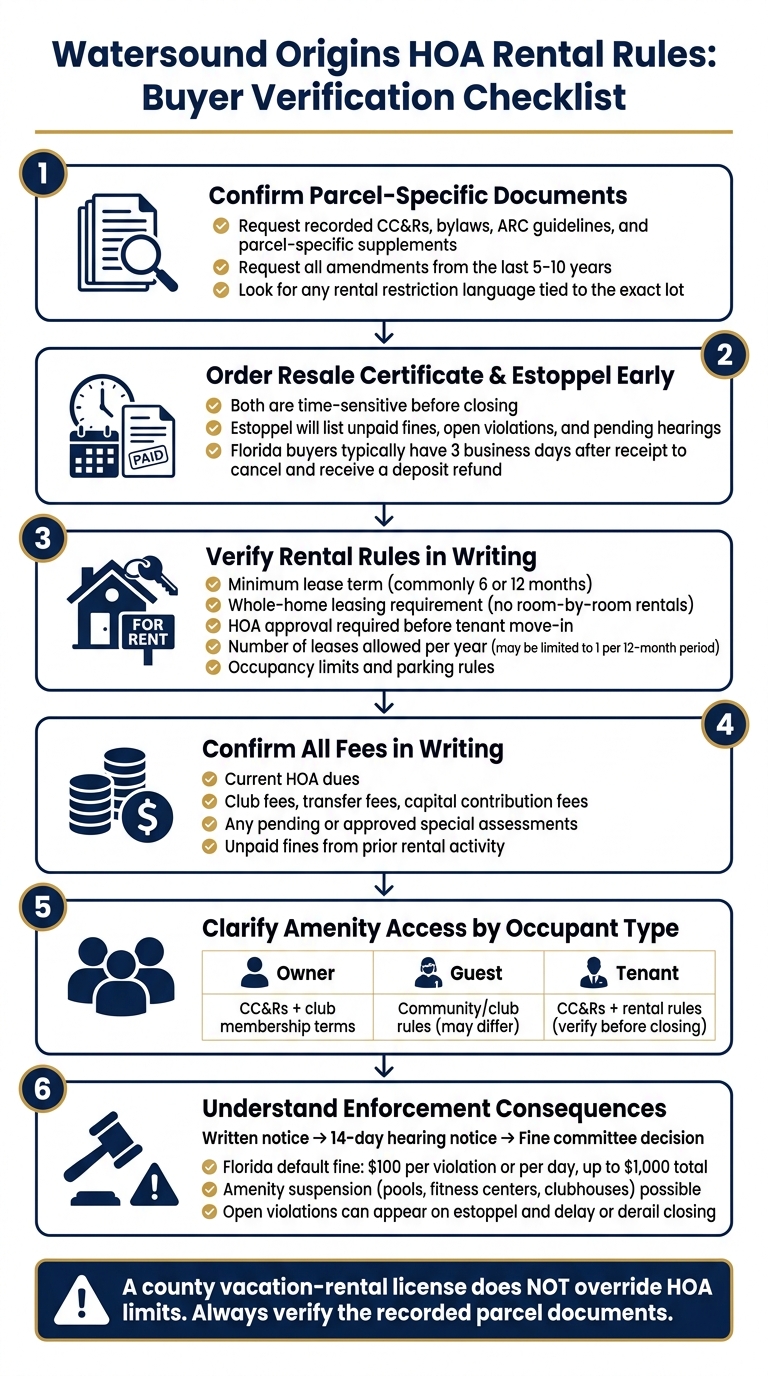
Watersound Origins HOA Rental Rules: Buyer Verification Checklist
Use this checklist to confirm the lease, fee, and approval rules tied to the exact parcel before you close.
Documents to request and read before the contract period ends
Ask for the recorded CC&Rs, bylaws, rules, ARC guidelines, and any parcel-specific supplements for the exact lot. You should also request all recorded amendments and supplemental declarations from the last 5 to 10 years. That step matters because leasing rules can change through amendments. If you only read the original CC&Rs, you could miss a newer rule that limits or blocks short-term rentals.
Order the resale certificate and estoppel early. Both are time-sensitive before closing. Florida also gives buyers a short cancellation window - commonly 3 business days - after receiving HOA documents to back out and get a deposit refund if the rules or costs don’t work for them.
Financial and use restrictions to verify in writing
Don’t stop with the governing documents. Get written confirmation of every cost tied to the property. Verify the current HOA dues, plus any club fees, transfer fees, or capital contribution fees, in writing. Check the estoppel for any special assessments that are already approved or still pending. Also confirm that there are no unpaid fines tied to earlier rental activity.
On the use side, get the rental rules in writing too. Verify:
- The minimum lease term
- Whether whole-home leasing is required
- Whether HOA approval is needed before a tenant moves in
- How many leases are allowed per year
- Occupancy limits
- Parking rules
Conclusion: Verify parcel-specific rules before counting on rental income
Before you count on rental income, confirm the recorded parcel rules and HOA limits in writing. Watersound Origins is generally short-term-rental-restricted. Check the parcel documents and HOA rules before closing. A county vacation-rental certificate does not override HOA limits.