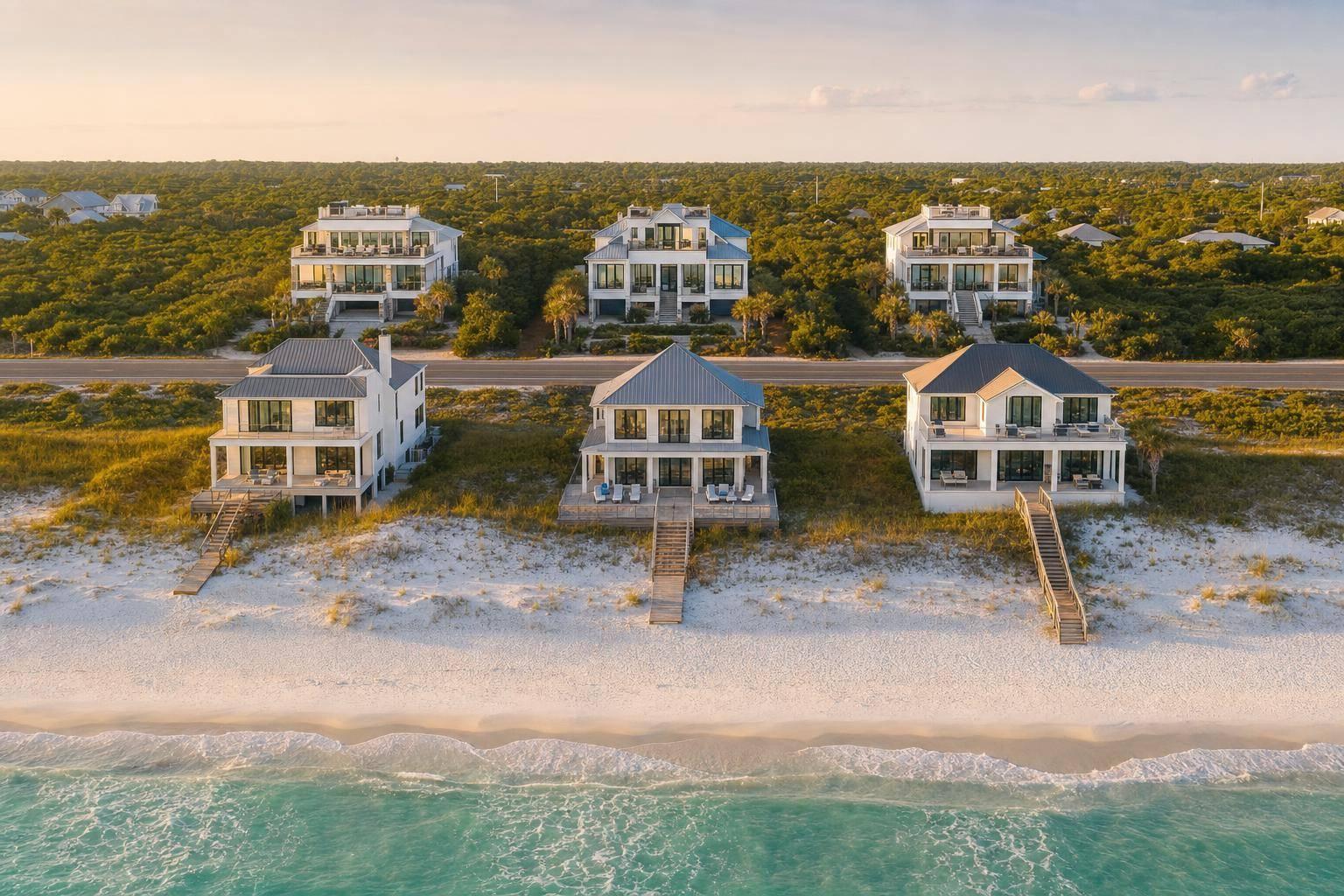
If I want the short answer: Gulf-front gives me the best view and direct beach access, while Gulf-view usually gives me a much lower buy-in and lower annual costs.
On 30A, that trade can be huge. The article shows 2026 Gulf-front single-family sales averaging about $9.73 million and about $2,255 per square foot. By comparison, near-beach Gulf-view homes in Seagrove often trade around $700 to $900 per square foot. Rental income is often higher on the front row, but so are insurance, upkeep, and storm exposure.
If I were comparing these two home types, I’d focus on:
- Purchase price
- Price per square foot
- Rental income
- View quality
- Beach access
- Flood and wind insurance
- Maintenance
- Resale demand
Bottom line: if I want a trophy beachfront property and easy sand access, Gulf-front fits best. If I want a Gulf view with a lower entry cost and easier long-term carrying costs, Gulf-view is often the better pick.
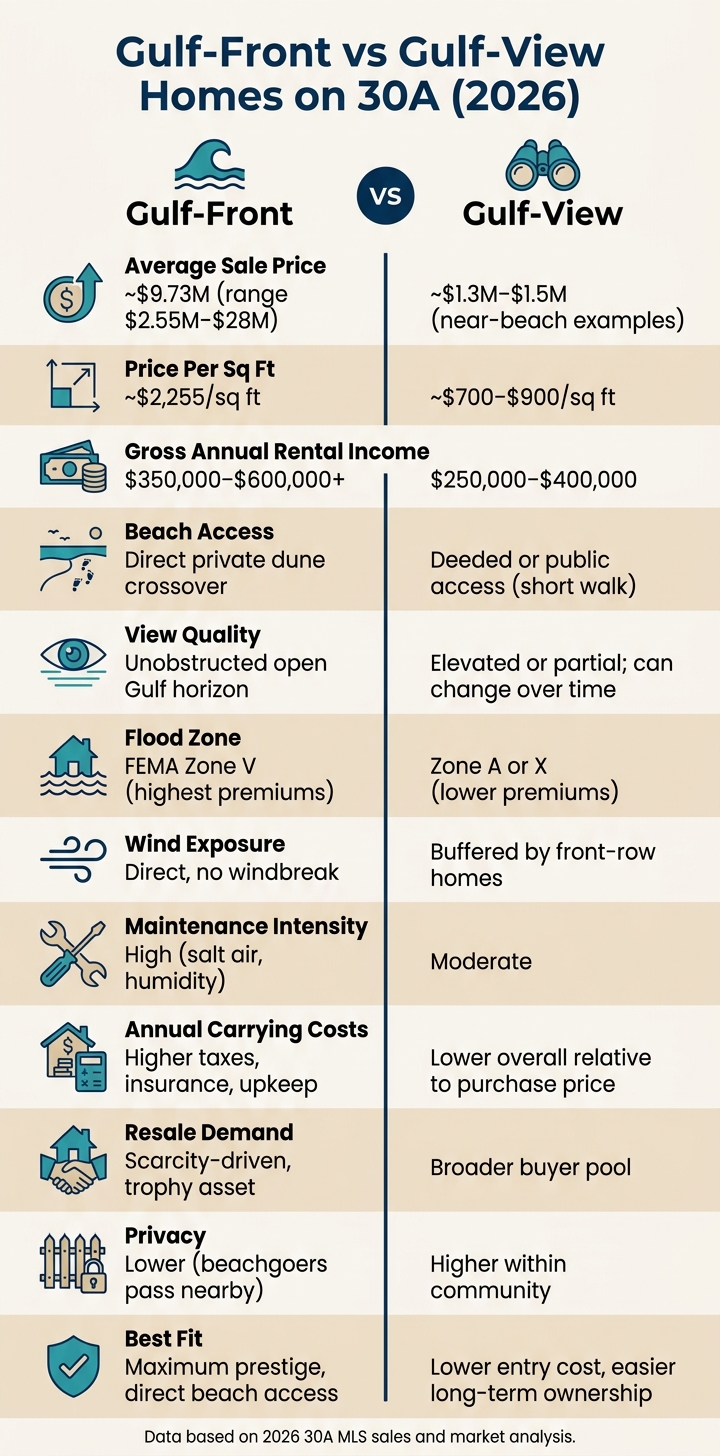
Gulf-Front vs Gulf-View Homes on 30A: Full Comparison 2026
Inside a $7.99 Million Gulf-Front Home on 30A
sbb-itb-d06eda6
Quick Comparison
| Factor | Gulf-Front | Gulf-View |
|---|---|---|
| Location | Directly on the Gulf | Can see the Gulf, but not on the beachfront lot |
| 2026 price level | Avg. $9.73M | Often far less; near-beach examples around $700–$900/sq. ft. |
| Rental income | $350,000 to $600,000+ gross | $250,000 to $400,000 gross |
| View | Open water view | Often upper-floor or partial view |
| Beach access | Direct, often by private crossover | Usually public vs. private beach access |
| Insurance and upkeep | Higher | Lower in most cases |
| Resale | Scarcity-driven | Larger buyer pool |
So before I buy on 30A, I’d weigh one simple question: Do I want the beach at my back door, or do I want a better price with fewer ownership costs?
Definitions: Gulf-front and Gulf-view homes on 30A
Gulf-front homes
Gulf-front homes sit right on the Gulf, with no road or extra lot between the house and the dune line.
That location usually puts them at the top of the market on 30A. It also means more exposure to storms, salt air, and flood-related costs. On 30A, that direct beachfront setting is what creates the biggest price premium.
Gulf-view homes
Gulf-view homes look out over the Gulf without owning the beachfront lot itself.
In many cases, the view comes from an upper floor, a rooftop deck, or a home set a bit farther back from the water. That usually brings the purchase price down and opens the door to more buyers. For many people, Gulf-view homes offer a more reachable way to buy into 30A neighborhoods.
That gap shapes the main trade-offs: price, private beach access, rental income, and long-term ownership costs. Next comes the price spread, rental upside, and day-to-day use differences that separate these two options.
Price and rental performance: frontage premium vs better entry value
Purchase price gap and what drives it
Once the home types are clear, the next step is simple: what does each one cost, and what can it bring in?
Gulf-front homes sit in a very different price tier than Gulf-view homes. A 2026 MLS review of single-family Gulf-front sales showed an average sold price of $9.73M, with prices ranging from $2.55M to $28M across 19 sales. The average price per square foot came in at about $2,255/sq ft.
Gulf-view homes are a different ballgame. In Seagrove Beach, for example, near-beach homes without frontage often trade in the $700–$900/sq ft range. That gap comes down to a few simple things: direct beach access, wide-open Gulf views, and the fact that true beachfront lots on 30A are hard to come by. On 30A, the pricing spread is basically a trade between waterfront real estate trends and a lower-cost way in.
Rental income, nightly rates, and occupancy patterns
Rental income tends to be higher for Gulf-front homes, but Gulf-view properties can make more sense when you weigh income against the purchase price.
For luxury short-term rentals on or near 30A, a Gulf-front estate can produce $350,000–$600,000+ in gross annual rental income. Gulf-view luxury homes usually land in the $250,000–$400,000 range each year. That's a real gap, no doubt. But the buy-in is also much higher on the front row.
There’s also a demand difference. Gulf-view homes often pull from a bigger renter pool, especially families and groups who want the 30A trip without the beachfront price tag. Gulf-front homes usually lead on nightly rate. Gulf-view homes often hold their own through booking volume. This reflects broader real estate trends in 30A neighborhoods where inventory and buyer leverage are shifting.
Comparison table: price, rental rates, occupancy, and buyer value
| Factor | Gulf-Front | Gulf-View |
|---|---|---|
| Avg. sold price | ~$9.73M (range: $2.55M–$28M) | Example near-beach pricing in Seagrove Beach: $1.3M–$1.5M |
| Price per sq ft | ~$2,255/sq ft | Near-beach homes often trade around $700–$900/sq ft |
| Gross annual rental income | $350,000–$600,000+ | $250,000–$400,000 |
| Guest profile | Luxury guests, rate-driven | Broader family demand, booking-driven |
| Best fit | Maximum prestige, scarcity, and income ceiling | Lower entry cost, still-strong rental appeal |
Price is only one piece of it. Sightlines and beach access have a big effect on how the home feels day to day, which is where the next part comes in.
Views, beach access, and daily use: what living on 30A actually feels like
View lines: open Gulf horizon vs elevated or partial sightlines
Price and rental income matter, of course. But day-to-day living is where Gulf-front and Gulf-view homes start to feel very different.
A Gulf-front home gives you the full picture: an open Gulf horizon, direct water views, and the steady sound of the surf. You're not looking toward the beach. You're right there at the edge of it.
Gulf-view homes can still be stunning, especially from upper-level decks and balconies. In many cases, the view is more than enough for owners who want that beach feel without being directly on the sand. The catch is simple: views can change. A new house next door or even mature trees and foliage can cut into those sightlines over time. That's why it helps to check nearby lots and look into any planned development or 30A gated community requirements before you buy.
Beach access: private dune crossover vs deeded and Walton County public access points
This is where daily life gets very practical.
Gulf-front owners usually go from the house to the sand almost instantly. For families hauling chairs, towels, toys, and a full cooler, that kind of direct access can make a big difference. The easier it is to get out there, the more often people tend to use the beach.
Gulf-view homeowners usually reach the beach through a deeded access path or a Walton County public access point. In some neighborhoods, that setup still feels pretty easy. Communities like WaterColor or Watersound may also include beach clubs and private walking trails through HOA amenities, which smooths out the routine. Still, there's a short walk built into the process. And when you're moving young kids or carrying gear in the Florida heat, that extra stretch can feel longer than it sounds.
Comparison table: view quality, access, privacy, and daily convenience
| Factor | Gulf-Front | Gulf-View |
|---|---|---|
| View type | Unobstructed horizon, direct surf presence | Elevated or partial; can change with construction or vegetation |
| Beach access | Private/semi-private dune crossover | Deeded neighborhood or Walton County public access |
| Access time | Immediate from the home | Short walk; varies by community |
| Privacy | Lower - beachgoers pass nearby | Higher within the community |
| Noise level | Constant surf sound | Quieter; more neighborhood-like |
| Walkability | Variable; depends on community | Often higher, especially in communities like Seaside, Rosemary Beach, and WaterColor |
| Best fit | Frequent in-and-out beach trips | Dining, trails, community amenities, and beach days |
For remote workers, the difference can shape the whole day. Gulf-front homes bring constant surf noise and a more immersed beach setting. Gulf-view homes, especially in walkable spots, often put coffee shops, restaurants, and local events much closer. That trade-off tends to matter more over time than buyers first expect.
Insurance, maintenance, and resale: long-term ownership trade-offs
Storm exposure, flood zones, and annual carrying costs
Annual carrying costs can split pretty sharply between Gulf-front and Gulf-view properties.
Gulf-front homes usually sit in FEMA Flood Zone V, where wave action leads to the highest flood insurance premiums. Gulf-view homes are more often in Zone A or Zone X, where flood insurance tends to cost less and, in some cases, isn't federally required. Even so, it's still a smart move for coastal property.
Wind exposure tends to follow the same pattern. Gulf-front properties take the full hit from the Gulf of Mexico with no structural windbreak in front of them. Gulf-view homes often get some protection from the first row of beachfront houses, which usually means lower wind insurance premiums. In both cases, owners often deal with hurricane deductibles instead of standard flat-dollar deductibles.
Salt air, humidity, and rough weather also wear down Gulf-front structures faster. HVAC systems, appliances, and exterior surfaces often need more attention, and that can drive annual maintenance costs above what you'd expect for Gulf-view homes set farther back from the dune line.
Those cost gaps don't just affect ownership. They also shape resale demand.
Resale appeal: scarce trophy properties vs broader buyer demand
Gulf-front homes on 30A are scarce, high-end properties. That tight inventory helps support strong demand over time.
Gulf-view homes tend to draw a bigger buyer pool, including second-home buyers, investors, and relocating families who want the 30A lifestyle at a lower entry point. Lower carrying costs and less direct exposure to coastal hazards can make these homes easier to keep over the long run, which helps resale demand. Put simply, higher carrying costs shrink the buyer pool, while lower costs open it up.
Comparison table and conclusion: which 30A option fits your priorities
Here’s the long-term trade-off at a glance.
| Factor | Gulf-Front | Gulf-View |
|---|---|---|
| Flood zone | FEMA Zone V; highest premiums | Zone A or X; lower premiums |
| Wind exposure | Direct; higher insurance cost | Buffered; moderate insurance cost |
| Maintenance intensity | High; salt air and humidity accelerate wear | Moderate; less direct exposure |
| Annual carrying costs | Higher taxes, insurance, and upkeep | Lower overall relative to purchase price |
| Resale strength | Scarcity-driven; trophy asset appeal | Broader buyer pool; strong entry-level demand |
| Buyer profile | Buyers prioritizing scarce, trophy-style ownership | Buyers prioritizing value and broader resale demand |
Gulf-front offers scarcity and prestige. Gulf-view offers lower carrying costs and broader resale demand.
FAQs
Which option is better for my budget?
For a more budget-friendly way into the 30A market, Gulf-view properties are usually the better pick.
Beachfront homes often sell for more than $9,000,000. By comparison, Gulf-view homes usually fall between $2,000,000 and $4,500,000, and condos can start at around $500,000.
There’s another plus here: Gulf-view homes can also come with lower ongoing costs. That may include insurance, maintenance, and HOA fees.
How much more does Gulf-front insurance cost?
On 30A, Gulf-front homes usually cost a lot more to insure than Gulf-view homes. The reason is pretty simple: they sit closer to the water and take on more risk from storm surge, high winds, and constant salt air.
Annual premiums often fall between $5,000 and $15,000+. That total may include homeowners insurance, windstorm coverage, and any flood insurance the lender or local rules require. If the property is used as a short-term rental, premiums can jump another 30% to 80%.
Is Gulf-view easier to resell on 30A?
Yes. Gulf-view properties on 30A are usually easier to resell than top-end Gulf-front homes.
Gulf-front estates are rare and prestigious, but the buyer pool is smaller. Most of those buyers are high-net-worth, which often leads to longer hold times.
Mid-market Gulf-view properties tend to move more easily. They’re often priced between $500,000 and $1.2 million, which puts them in front of a much broader group of vacation-home buyers and investors.
Put simply: more people can shop in that price range, so resale tends to be smoother.