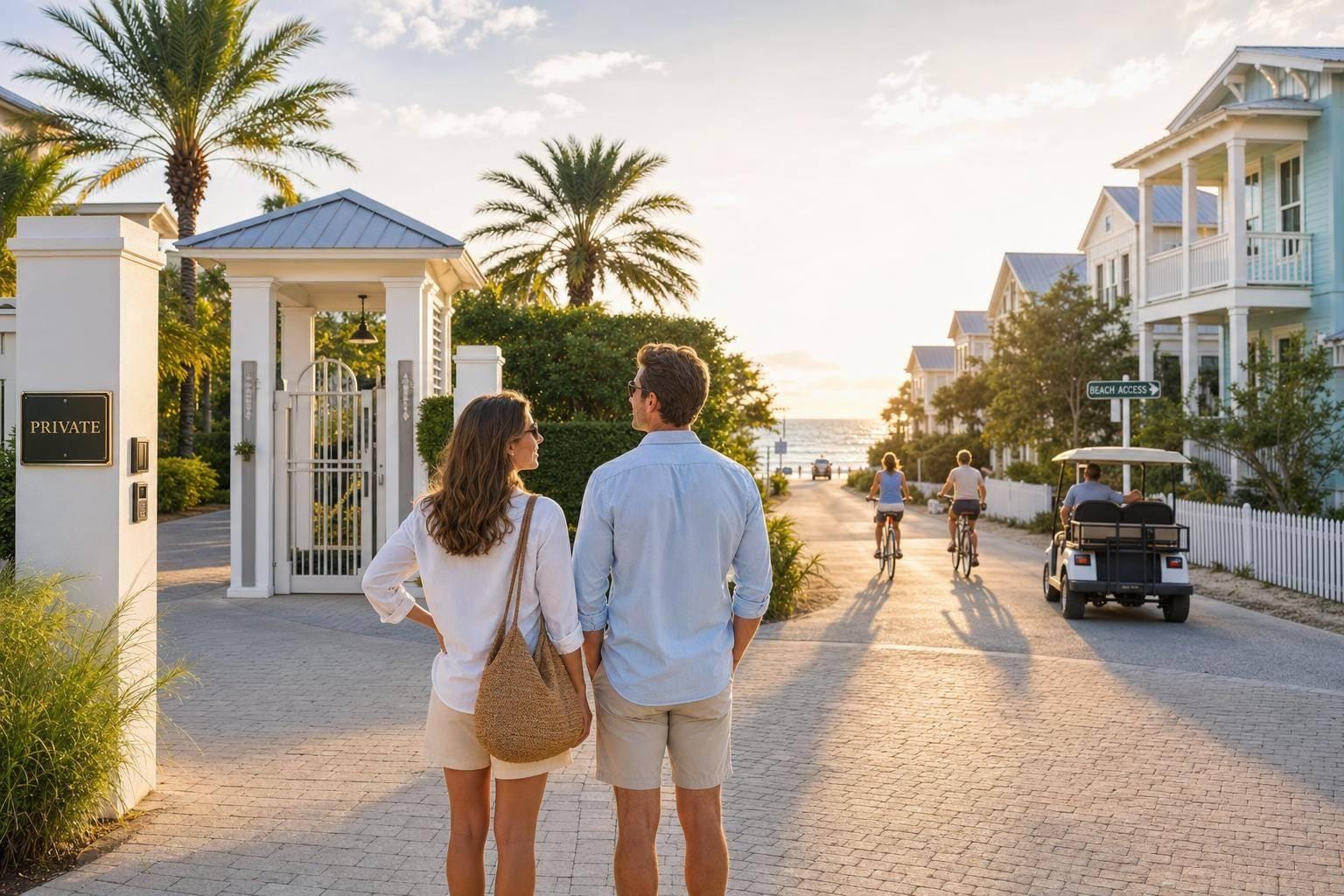
If you want more privacy, less cut-through traffic, and a more controlled setup, gated communities usually fit better. If you want easier guest access, fewer rules, and lower monthly costs, open communities often make more sense.
I’d boil this choice down to five things: traffic, beach access, HOA rules, monthly costs, and rental flexibility. On 30A, gated homes often cost about 10% to 25% more, and some communities add dues that can reach about $613 per month. Open areas usually cost less to carry month to month, but you take on more yourself.
Before I look at any listing, I’d ask:
- Do I want quiet streets or easy access?
- Am I okay with zoning and HOA rules and guest entry steps?
- Will I use the home for full-time living, a second home, or short-term rentals?
- Do I want private or managed beach access, or am I fine with public access points and parking?
Quick comparison
| Criteria | Gated Communities | Open Communities |
|---|---|---|
| Traffic | Lower inside the neighborhood | More seasonal traffic and cut-through use |
| Privacy | More separation from public streets | Less controlled setting |
| Guest entry | Slower; often needs approval or codes | Simple and direct |
| Beach access | Often private or managed | Often public access and public parking |
| HOA rules | More rules on rentals, design, and parking | Fewer neighborhood-level rules |
| Home price | Often 10%–25% higher | Often lower entry point |
| Monthly costs | Higher dues in many cases | Lower dues or none |
| Walkability | Varies; sometimes more internal than town-centered | Often closer to shops, dining, and trails |
| Rental use | Often more limited | Often easier for vacation rentals |
Bottom line: I’d choose gated for privacy, order, and calmer streets. I’d choose open for freedom, guest convenience, and easier day-to-day access.
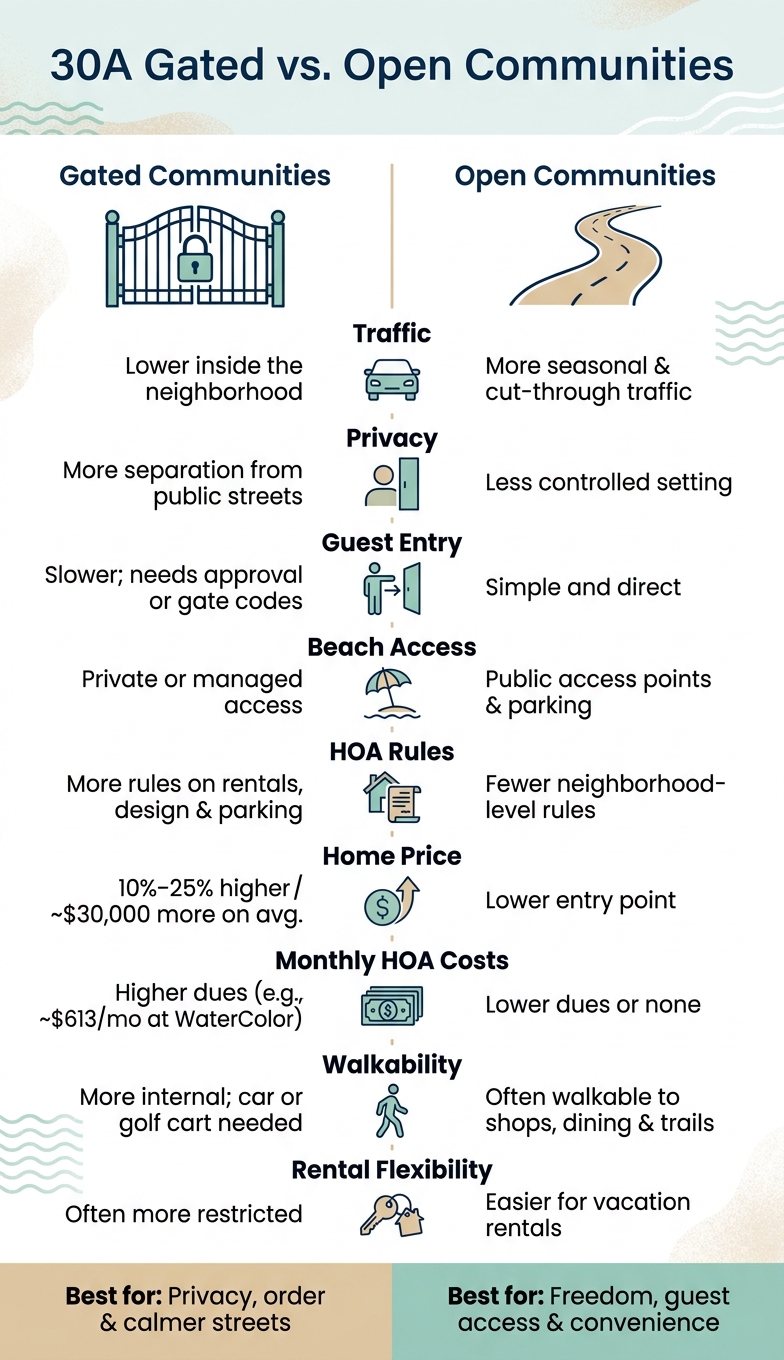
30A Gated vs Open Communities: Side-by-Side Comparison
Brutally Honest Pros and Cons Living on 30A | UPDATED 2025
sbb-itb-d06eda6
Privacy, Traffic, and Access
The biggest day-to-day gap between gated and open communities on 30A comes down to traffic and access. And that changes a lot more than you might think. It affects how quiet a neighborhood feels, how safe the streets seem, and how easy it is for people to come and go.
| Factor | Gated Communities | Open Communities |
|---|---|---|
| Traffic and safety | Less through-traffic; calmer for children, cyclists, and golf cart users | Can be used as cut-throughs by tourists trying to avoid congestion on Scenic Highway 30A |
| Visitor access | Slower; guests may need access approval | Easier, with no controlled entry |
Privacy and Security Feel
Less traffic changes the mood of a neighborhood. In a gated community, controlled entry and lighter traffic can make the streets feel quieter and more tucked away. There’s a sense of separation from the busier parts of 30A.
Open communities don’t have that same layer between residents and the outside world. Streets stay open to everyone, which creates a less controlled setting and usually brings more foot traffic.
Traffic and Daily Movement
Gated communities on 30A cut down on through-traffic, which can make the streets feel safer for children, cyclists, and golf cart users. Open neighborhoods, by comparison, often feel busier during spring and summer.
This stands out most during peak seasons, when more drivers may use open neighborhoods as a shortcut through residential streets. Inside gated communities, internal roads tend to stay calmer. That can make bike rides, school runs, and golf cart trips feel a bit easier day to day.
Guest Entry and Beach Access
The same controls that keep traffic down also shape how people get in. Gated communities use gate checks or resident-approved entry to manage access. For residents, that often means a little more planning for deliveries, contractors, and guests.
Open communities are simpler for visitors, service providers, and day-to-day arrivals because there are no controlled entry points. Beach access works in a similar way: gated communities often use private or managed paths, while open communities usually rely on public access points.
Rules, Costs, and Ownership Trade-Offs
Rules and costs split more sharply in this part of the decision.
| Factor | Gated Communities | Open Communities |
|---|---|---|
| Purchase price | Higher; often 10%–25% more than comparable non-gated homes | Lower entry point in many cases, though beachside locations can narrow the gap |
| HOA fees | Higher dues for security, amenities, and shared maintenance | Lower or no HOA fees; owners often pay for services individually |
| Amenity costs | Bundled into dues, such as pools, clubhouses, beach access, and fitness centers | Unbundled; owners pay separately for the amenities they use |
| Maintenance responsibility | HOA handles common areas and shared spaces; owners handle their own homes | Owners handle more of the maintenance themselves |
HOA Rules and Community Standards
If access affects day-to-day ease, rules affect how much freedom owners have.
Gated communities on 30A usually come with detailed community rules. Those rules often cover paint colors, roofing materials, fencing, landscaping, and even mailbox style. In most cases, any exterior change needs design review approval before work starts. Short-term rentals are also often limited, with minimum stay rules, rental caps, or outright bans in some subdivisions to keep a quieter residential feel. Parking rules may also block overnight street parking or limit RV and boat storage in driveways.
Open communities usually have much less oversight. Exterior updates may only need county permit approval instead of HOA design review, which gives owners more room to personalize their homes. Short-term rental rules in South Walton are often more flexible at the neighborhood level, with most limits coming from county ordinances instead of a private association. Owners in these areas should consult the Walton County short-term rental permit guide to ensure compliance with local registration and occupancy requirements.
That said, more freedom cuts both ways. You usually have less power to object if a neighbor’s property slips into disrepair or turns into a high-turnover short-term rental. That kind of control often comes with higher dues.
Home Prices and Carrying Costs
The same control that brings consistency also pushes up prices and dues.
Research has long shown a price premium for gated communities. A study summarized by the American Real Estate Society found that homes in gated communities sell for roughly $30,000 more on average than comparable non-gated homes. On 30A, that premium often reflects bundled amenities, architectural consistency, and controlled access.
HOA fees show the same pattern. WaterColor is a good example of how fast dues can climb: a single-family home can carry about $613 per month in combined assessments. You’re paying for a more managed setup, but that doesn’t always mean a lower total cost of ownership.
Open communities with little or no HOA usually keep recurring costs lower. But owners often pay out of pocket for yard care, pool service, and optional amenities. So the trade-off is pretty plain: more structure and more services on one side, more freedom and more personal responsibility on the other.
Daily Living on 30A
Day-to-day fit usually comes down to three things: noise, convenience, and how easy it is for guests to come and go. That’s where the main trade-off starts to feel less abstract and a lot more personal.
| Factor | Gated Communities | Open Communities |
|---|---|---|
| Daily routine | Quieter mornings and fewer interruptions | More foot traffic and street activity |
| Neighborhood feel | More private and predictable | Closer to shops, dining, and beach access |
| Convenience | Often needs a car or golf cart for off-site errands | Often walkable to the Timpoochee Trail, dining, and the beach |
| Social flow | Fewer drop-ins and less street activity | More activity from neighbors and visitors |
Lifestyle Fit by Resident Type
These differences make the most sense when you line them up with how you live.
Full-time residents who want a calmer setting often lean toward gated communities like Watersound Beach or Vizcaya. Controlled access cuts down on through-traffic, which can make a big difference during peak season. The downside is pretty simple: getting a contractor, delivery driver, or friend through the gate can take extra coordination.
Second-home owners can do well in either setup. If you want your place to feel like a tucked-away retreat, a gated community can be a good fit. If you expect family and friends to visit often, the extra step of guest entry can feel like a hassle.
Vacation-rental owners often lean toward open communities like Seaside, Seagrove, or Grayton Beach. Guests can arrive without dealing with gate codes, and easy walking access to restaurants and the beach is a strong selling point for short-term renters.
Connection to the Broader 30A Scene
Open communities tend to feel more plugged into the day-to-day rhythm of 30A. In many cases, they sit closer to shops, dining, and trail access, so daily life feels more tied to the broader 30A experience.
Gated communities put more space between you and the seasonal crowds, which often means a quieter daily routine. That privacy matters. But so does the extra distance from dining, beach access, and the laid-back local energy that shapes open stretches of 30A.
That’s the trade-off in plain English: more buffer or more access. Once you know which side matters more to you, the choice gets a lot easier.
Which Option Fits Your Priorities
Matching Your Priorities to the Right Community Type
Once you know what matters most, the choice gets a lot simpler. It comes down to one main thing: which trade-off are you more comfortable with?
| Your Priority | Better Fit |
|---|---|
| Controlled access | Gated communities, such as Rosemary Beach and Seacrest |
| Easy guest access | Open communities, such as Inlet Beach |
| Walkability and beach access | Gated communities |
| Fewer HOA rules | Open communities |
| Architectural consistency | Gated communities |
| Proximity to state parks and natural access | Open communities like Inlet Beach, near Camp Helen State Park |
Use the table as a quick filter. Then narrow your choice based on how much privacy, access, and HOA structure you want.
If privacy and predictability sit at the top of your list, a gated community is usually the better match. You get public vs. private beach access, more consistent architecture, and a more curated day-to-day setting.
If flexibility and easier access matter more, open communities tend to make more sense. That can be a big deal for guests, short trips, or simple daily convenience. Inlet Beach, for example, has public beach parking, fewer HOA restrictions, and a quieter, Old Florida feel.
Before you make a call, look at rental rules too. Walton County requires registration and sets limits on occupancy and parking, and managed communities often add stricter rules.
FAQs
How do I choose between a gated and open community on 30A?
Choose based on what matters most to you: privacy and access control or cost and flexibility.
Gated communities often mean quieter streets, less cut-through traffic, controlled guest entry, and possible rental limits. That can feel like a relief if you want more privacy and fewer surprises.
Open communities usually feel easier to move through day to day. They can seem more walkable and social, with less friction for guests and errands. The trade-off? You may deal with more crowds and tougher parking.
Either way, don’t buy based on the front gate alone. Review the HOA or CC&R documents, check rental and zoning rules, and look closely at HOA fees and reserve funding before you make a move.
Are gated communities worth the higher monthly costs?
It comes down to what matters most to you: privacy, ease, or keeping costs lower.
Gated communities often come with HOA fees of $6,000 to $30,000 per year. In return, you’re usually paying for perks like 24/7 security, private beach access, resort-style pools, and professional landscaping.
For buyers who want a lock-and-leave lifestyle, less through-traffic, and a quieter setting, that extra cost may feel well worth it. On the other hand, if keeping overhead down is the bigger goal, open 30A communities can be a more budget-friendly option.
Which type is better for short-term rentals on 30A?
It depends on your financial goals and the kind of guest experience you want to offer. Gated and open communities aren't automatically better or worse. The big factor is the HOA rules, which can allow, limit, or ban short-term rentals in either setup.
If rental income is the main goal, places like Rosemary Beach and Seaside can be strong picks. Demand is high, and the rental setup is already in place, which can make things easier.
If you'd rather have more privacy or less guest turnover, a restricted community may fit better. Either way, always review the property's CC&Rs.