
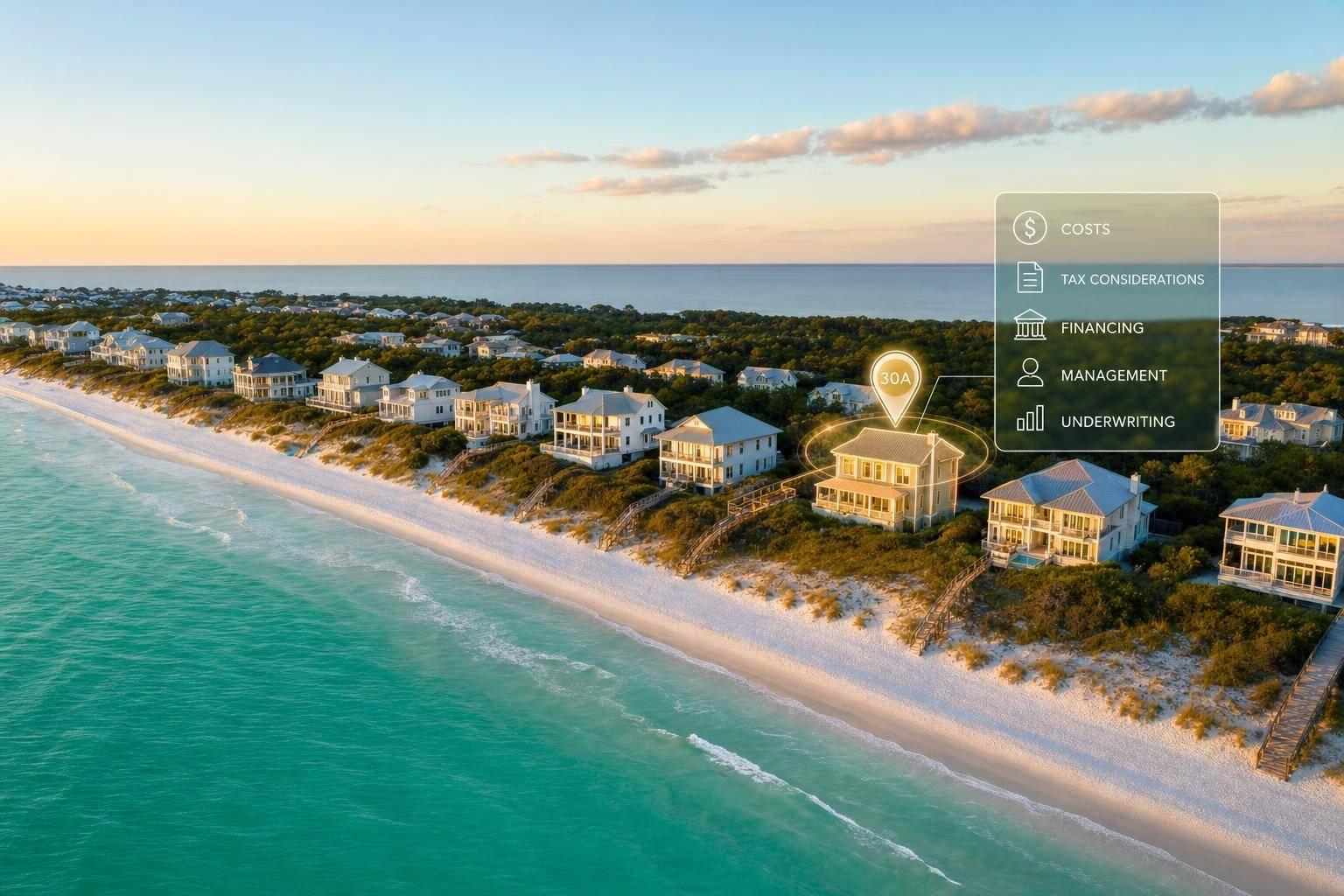
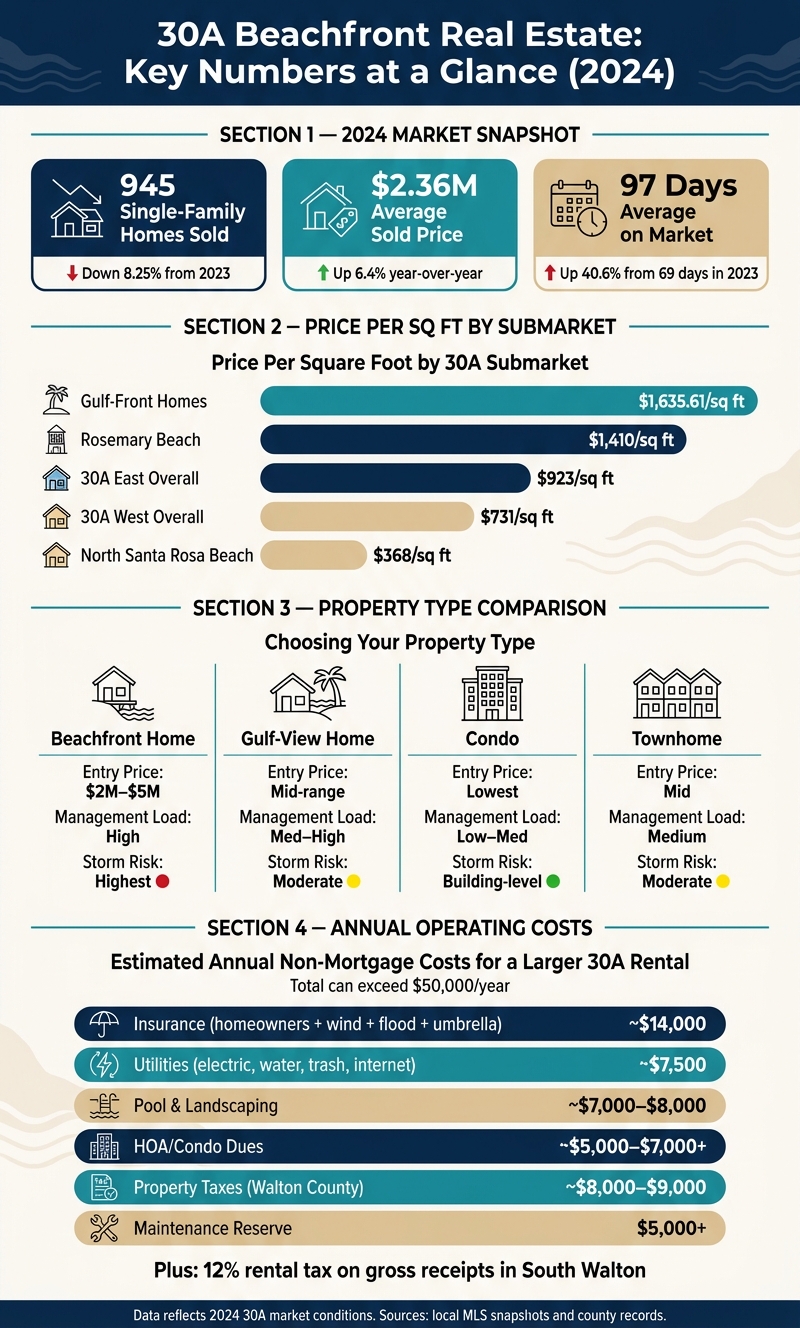
30A beachfront investing can work, but only if the numbers still hold after high insurance, taxes, HOA dues, maintenance, and management fees. In 2024, about 945 single-family homes sold along 30A, the average sold price hit about $2.36 million, and average days on market stretched to about 97 days. That tells me this is still an active market, but buyers need to underwrite deals with more care.
If I were sizing up a 30A deal in 2026, I’d focus on four things first:
- Location: East vs. West 30A usually costs more and gets stronger rental demand than West 30A or inland areas.
- Property type: Gulf-front homes vs. non-Gulf-front properties have the top rate potential, but they also come with the highest storm, wear, and insurance costs.
- Rules and taxes: Short-term rentals need state and county setup before booking, and total rental taxes can run about 12% of gross receipts in South Walton.
- Cash flow: Annual non-mortgage costs for a larger beach rental can go past $50,000.
A few numbers stand out right away:
- Gulf-front homes in one local snapshot averaged about $1,635.61 per square foot
- Non-Gulf-front homes averaged about $375.48 per square foot
- Rosemary Beach averaged about $1,410 per square foot
- North Santa Rosa Beach averaged about $368 per square foot
- Professional management may take about 15% to 35% of gross revenue
30A Beachfront Real Estate: Property Types & Market Snapshot 2024
Investing in 30A: 2025 Rental Market Data Every Investor Should See
sbb-itb-d06eda6
Quick Comparison
| Area or Item | What I’d expect |
|---|---|
| East 30A | Higher prices, stronger rental pull, slower resale pace |
| West 30A | Lower entry cost, more room to negotiate, longer market times |
| North Santa Rosa Beach | Much lower price per square foot, different buyer and renter profile |
| Gulf-front home | Top nightly rate potential, top insurance and upkeep burden |
| Gulf-view home | Lower cost than Gulf-front, still strong guest demand |
| Condo or townhome | Lower entry point, easier day-to-day ownership, more HOA review needed |
The short version: 30A is not just a beach-home purchase. It’s a tight-supply coastal investment where community choice, rental rules, tax setup, and storm-related costs shape returns as much as the purchase price. Below, I break down what I’d check before I make an offer.
30A Market Trends and Investment Benchmarks
In 2024, about 945 single-family homes sold along 30A. That was down about 8.25% from 2023. At the same time, the average sold price climbed 6.4% to about $2.36 million. The market didn’t stop moving, but it did slow down a bit. Average days on market reached about 97 days, up 40.6% from 69 days the year before. Homes are still selling, but deals are taking more time to come together.
Those figures give you a starting point for comparing East 30A, West 30A, and the inland areas.
Breaking Down the 30A Market by Area
30A doesn’t move as one single market. East 30A - including Alys Beach, Rosemary Beach, Seaside, Watersound, Seagrove Beach, and Inlet Beach - tends to post higher prices and stronger rental demand than West 30A and inland Santa Rosa Beach. This demand fluctuates significantly based on 30A rental occupancy trends throughout the year.
West 30A, which includes Blue Mountain Beach, Dune Allen, and Gulf Place, tends to draw buyers looking for better entry pricing and a mix of primary-home and second-home use. North Santa Rosa Beach sits farther inland and acts like its own submarket.
A November 2024 snapshot showed just how wide the gap is between top-tier beach communities and the more budget-minded areas. Rosemary Beach averaged $1,410 per square foot, while North Santa Rosa Beach averaged $368 per square foot.
| Submarket | Avg. Price/Sq. Ft. | Avg. Days on Market | Sold-to-List Ratio |
|---|---|---|---|
| Rosemary Beach | $1,410 | 121 days | ~89% |
| 30A East (overall) | $923 | 98 days | ~93% |
| 30A West (overall) | $731 | 176 days | ~91% |
| North Santa Rosa Beach | $368 | 84 days | ~90% |
Put simply, East 30A usually means higher prices and slower turnover. West 30A often gives buyers more room to negotiate, if they’re willing to wait. That difference matters when you’re picking both a neighborhood and a property type.
Key Numbers to Check Before Making an Offer
Before you make an offer, pull the numbers for the exact submarket and property type you want. Broad 30A averages help, but they won’t tell the whole story for a condo in Seagrove Beach or a house in Dune Allen.
Focus on:
- Median sale price
- Average sale price
- Price per square foot
- Days on market
- Inventory or months of supply
- Sold-to-list ratio
Each metric shows a different part of the picture. Some tell you about pricing pressure. Others show how easy, or hard, it may be to buy and later sell.
List-to-sale ratios usually ran 95% to 98% in the strongest segments. West 30A came in closer to 87% to 91%. That gap gives you a pretty good read on negotiating room. About half of 2024 30A sales were all-cash. If you’re using financing, a strong pre-approval and clean offer terms can make a bigger difference.
Luxury Gulf-Front vs. Mid-Market Beach Properties
These two parts of the market play by different rules.
Luxury Gulf-front properties tend to attract high-net-worth second-home buyers, cash purchasers, and lifestyle-driven buyers. Scarcity and prestige drive demand here, but the buyer pool is smaller. That usually means a longer hold, higher carrying costs, and a slower resale path. The upside is tied more to long-term appreciation than short-term income. Regardless of the property type, investors must set seasonal rates accurately to maximize their yield.
Mid-market beach-area properties - roughly $500,000 to $1.2 million - account for most sales. They draw a broader set of vacation-home buyers and investors. Because of that, they’re usually easier to finance and easier to resell than top-end Gulf-front homes.
A simple way to think about it: Gulf-front is often the appreciation play, while mid-market beach properties tend to fit buyers who care more about cash flow and resale flexibility.
Picking the Right 30A Community and Property Type
How Community Character Shapes Returns
Once you know the price ranges, the next step is figuring out which community fits your guest and your exit plan.
Walkable master-planned villages often support higher nightly rates. More relaxed beach areas may trade at lower rates, but they can keep occupancy more stable. That difference matters. Community character affects both income and resale liquidity. Put simply, a neighborhood’s identity shapes who books, what they’ll pay, and how fast you can sell.
For neighborhood character, events, and local context, sowal.co can help you line up a community with your target guest.
After that, narrow your options based on operating cost, insurance exposure, and management load.
Beachfront Homes, Gulf-View Homes, Condos, and Townhomes Compared
Each property type brings its own mix of rental upside, work required, and resale options.
Beachfront single-family homes usually earn the highest nightly rates. In premium communities, they often trade between $2 million and $5 million. But that upside comes with heavier costs. Annual premiums for Gulf-front homes in high-hazard flood zones (Zone VE) often fall between $5,000 and $15,000+. Add frequent turnover from large groups and high guest expectations, and professional management is often the practical move.
Gulf-view homes cost less than a similar Gulf-front home in the same community. They also tend to have somewhat lower operating costs, while still drawing strong rental demand.
Condos lower the entry point and make day-to-day ownership easier, especially in buildings with on-site staff or amenities.
Townhomes sit somewhere in the middle. You get more bedrooms and privacy than a condo, a lower price than a detached home, and a moderate level of management work.
| Property Type | Typical Use Case | Management Intensity | Rules and Dues | Storm Risk |
|---|---|---|---|---|
| Beachfront Home | Multi-gen family trips, high-end retreats | High - large groups, complex turnovers | Master HOA with strict design and rental rules; private beach/boardwalk obligations common | Highest surge and erosion exposure; top-tier wind and flood insurance required |
| Gulf-View Home | Upscale families wanting view + value | Medium to High - heavy peak-season use | Smaller HOAs or platted subdivisions; some shared access/road maintenance | Moderate wind and surge risk; salt exposure but less dune responsibility |
| Condo | Couples, small families, first-time investors | Low to Medium - smaller unit, frequent turnovers | Strong condo docs; monthly dues; shared reserves; possible required rental manager | Building-level hurricane risk; assessments likely after major storms |
| Townhome | Families wanting more space than a condo | Medium - more bedrooms, easier than large homes | HOA may cover roof/exterior or only common elements; rules vary widely | Similar to homes but with shared walls; resilience depends on construction and elevation |
The last filter is paperwork. A property may look great on paper, but association rules can limit or even block its rental income.
What to Check in HOA and Condo Documents Before Closing
HOA and condo documents can decide whether a property is even usable as a short-term rental.
The first thing to check is zoning and short-term rental restrictions. Look for minimum stay rules, annual rental caps, or requirements to use an on-site rental desk or approved manager. Then review pet rules, parking limits, occupancy caps, reserve funding, special assessments, and master insurance coverage.
A local real estate attorney should review these documents before closing.
Financing, Taxes, and Walton County Compliance
Financing Options for 30A Investment Purchases
Once HOA and condo rules are sorted out, financing is the next hurdle. How you plan to use the property shapes the loan type, down payment, and reserve rules.
A second-home loan usually works best for limited rental use. Plan on 10%–15% down, a DTI under 43%–45%, and 2–6 months of PITI reserves. Most lenders also won't count short-term rental income here.
An investment-property loan makes more sense if you plan to rent the home on a regular basis. In most cases, that means 20%–25% down plus tighter reserve rules. Lenders often count about 75% of documented rental income, but usually only after you have 12–24 months of filed Schedule E returns. If you're hoping projected short-term rental income will help you qualify, that usually doesn't fly without tax return history.
A cash purchase can make closing simpler and removes lender reserve rules from the equation. In a competitive coastal market, that can be a big plus.
Lenders will also want to see wind and flood insurance, and those policies can affect both approval timing and closing costs.
Florida Rental Taxes and Federal Tax Treatment
If the property will bring in short-term rental income, taxes matter just as much as financing. Vacation rentals come with state, county, and federal tax rules, and the details can change your numbers fast.
Florida charges a 6% state sales tax on taxable rentals of living or sleeping accommodations for six months or less, plus any county discretionary sales surtax that applies. In South Walton, the 30A area also adds a 5% Tourist Development Tax (TDT) on gross taxable rental charges. That includes rent and nonrefundable cleaning, pet, and resort fees. Put together, the short-term rental tax load in this area is about 12% of gross rental receipts.
There’s a clear line between short-term and long-term use. Leases longer than six consecutive months to the same tenant are exempt from both Florida transient rental tax and Walton County TDT. That alone can shift the math in a big way.
Federal tax treatment has its own rules. The IRS treats a home as a personal residence when personal use goes over the greater of 14 days or 10% of rental days at fair market value. If you rent the property for 14 days or fewer, the income is usually not reported, and the related expenses are not deductible either. For mixed-use homes, you have to allocate use day by day.
| Classification | Personal Use | Rental Income Reported | Rental Deductions Allowed |
|---|---|---|---|
| Pure rental | None or minimal | Yes - full rental income | Yes - full rental expenses |
| Mixed-use vacation home | Exceeds 14 days or 10% of rental days | Yes - rental portion only | Limited - must allocate by days of use |
| Personal-use home with limited rental | Primary use; rented ≤14 days/year | No | No |
Walton County Short-Term Rental Registration and Rules
Owning the property isn't enough. In 30A, legal short-term rental operation also depends on county registration.
Walton County requires registration before any booking. The county defines a short-term rental as any stay of 30 days or less, and each dwelling unit must have its own Vacation Rental Certificate, renewed every year.
To operate legally, you need to complete three separate registrations:
- Apply for a Florida Certificate of Registration so you can collect and remit state sales tax
- Set up a Walton County TDT account with the Clerk of Court's TDT Department
- Get your county Vacation Rental Certificate
All three need to be in place before you start operating.
Local rules also require a 24/7 responsible party, plus compliance with safety and occupancy standards and annual certificate renewal. If you operate without current compliance, you can face civil penalties, a forced stop to rental activity, and back-tax liability with interest. A simple compliance calendar can help a lot here - track renewal dates, filing deadlines, and personal-use days in one place.
Running the Property and Planning Your Exit
The True Cost of Owning a Beachfront Rental on 30A
After financing and compliance, operating cost is what decides whether a deal actually cash flows.
A lot of investors miss this. On 30A, the non-mortgage cost of running a beachfront rental can get high fast. For a well-placed larger home, annual operating expenses can easily go past $50,000 per year once you count every line item.
Here’s what a mid- to upper-end 30A rental home may cost each year:
| Expense Category | Estimated Annual Cost |
|---|---|
| Insurance (homeowners + wind + flood + umbrella) | ~$14,000 |
| Property taxes (Walton County) | ~$8,000–$9,000 |
| HOA/condo dues | ~$5,000–$7,000+ |
| Utilities (electric, water, trash, internet) | ~$7,500 |
| Pool and landscaping | ~$7,000–$8,000 |
| Maintenance reserve (salt-air wear, repairs) | $5,000+ |
On 30A, paying a premium price only works when those repeat costs fit the income model.
And beach wear is no joke. Salt air eats through metal fixtures, railings, and AC units faster than many buyers expect. Exterior paint, deck sealing, and window hardware also need attention more often. Then there are bigger-ticket items: pool resurfacing and equipment replacement can hit in chunks of several thousand dollars. HOA special assessments can show up too.
That math only holds if your occupancy and nightly rates can carry it.
Self-Management vs. Professional Property Management
Self-managing lets you keep more of the top-line revenue, but it still takes work. Expect about 10–20 hours a month to handle guest messages, pricing, vendor scheduling, and compliance yourself.
Professional managers usually charge 15%–35% of gross revenue. In return, they cut down the day-to-day workload. This choice affects both occupancy and net income, so it should be part of the underwriting from day one, not something you figure out later.
| Factor | Self-Management | Professional Management |
|---|---|---|
| Time commitment | ~10–20 hrs/month | ~1–2 hrs/month |
| Occupancy rate | ~52% | ~71% |
| Gross revenue (4BR example) | ~$88,254 | ~$126,000 |
| Management fee | 0% | 15%–35% |
| Pricing strategy | Manual/basic | Dynamic revenue management |
On 30A, local boutique managers often charge 15%–20% and may suggest proactive maintenance budgets of $3,000–$6,000 per year. National brands can range from 10%–30%, and they often tack on guest-facing booking fees. The right setup comes down to how close you live, how much time you have, and whether you already have solid local vendors.
Conclusion: What Makes a 30A Investment Work
The best 30A deals line up property type, operating cost, and management style with the buyer’s return target.
A 3.8x seasonal revenue swing can wipe out summer gains if costs get too high. That’s why the strongest buyers underwrite expenses with care, choose the right segment, and decide on management before closing. If the deal still works after insurance, taxes, HOA dues, and management, then the property works.
FAQs
Is 30A better for cash flow or appreciation?
On 30A, the goal is usually a balanced total return. It’s not about picking cash flow or appreciation and treating them like opposites.
That matters because high interest rates and rising coastal insurance costs can leave year-one cash flow flat or even negative. So if you judge a property on cash flow alone, you’re probably missing the bigger picture.
In most cases, long-term wealth comes from a mix of factors:
- Rental income
- Equity paydown
- Tax benefits
- Steady appreciation driven by land scarcity and strong tourism demand
That’s why cash flow by itself is a weak way to measure success in this market.
How much cash should I reserve beyond the down payment?
Beyond the down payment, plan to set aside about 1% of the purchase price each year in a dedicated maintenance reserve.
You’ll also want liquid cash on hand for ongoing costs such as property taxes, insurance, annual Vacation Rental Certificate fees, and the routine replacement of big-ticket items like appliances, mattresses, and interior paint.
Which 30A property type is easiest to manage?
Condominiums are usually the easiest type of 30A property to manage. In many cases, HOA fees cover much of the day-to-day upkeep, including landscaping and shared amenities like pools and gyms.
Single-family homes give you more control and can bring in more rental income. But they also come with more hands-on work, from maintenance and repairs to yard care. Gulf-view properties tend to be simpler to maintain than beachfront estates, which deal with harsher exposure to salt, wind, and sand.